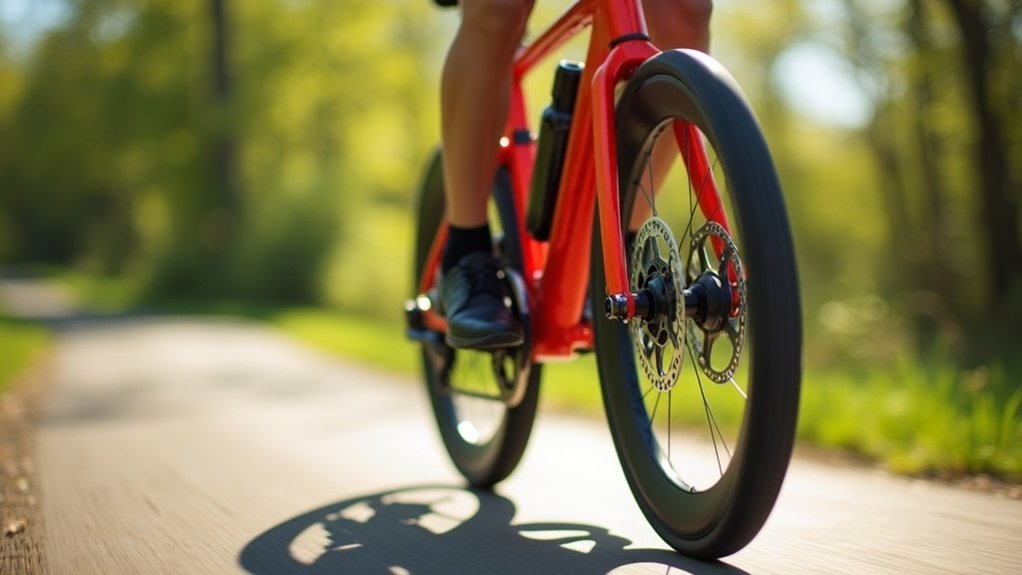
Hydraulic brakes are recommended for faster e-bikes because they provide superior stopping power and responsive control. They require less hand effort while delivering 20-30% more braking force than mechanical systems. This allows you to modulate your stopping power precisely at high speeds. Their sealed design guarantees reliability in various conditions, minimizing the effects of dirt and moisture. If you want to explore how they improve performance and maintenance, there’s more to discover.
Key Takeaways
- Hydraulic brakes provide 20-30% more braking force, essential for safely stopping faster e-bikes.
- They offer superior control for precise modulation of braking force at high speeds.
- The sealed design minimizes the impact of dirt and moisture, ensuring reliable performance in any condition.
- Hydraulic systems dissipate heat effectively, reducing brake fade during aggressive riding.
- Maintenance is less frequent, with longer-lasting brake pads, making them ideal for high-performance e-bikes.
Understanding Hydraulic Brake Systems
When you pull the brake lever on your e-bike, hydraulic brake systems spring into action by using fluid to transfer force from the lever to the caliper. This design offers superior stopping power and responsiveness compared to mechanical brakes.
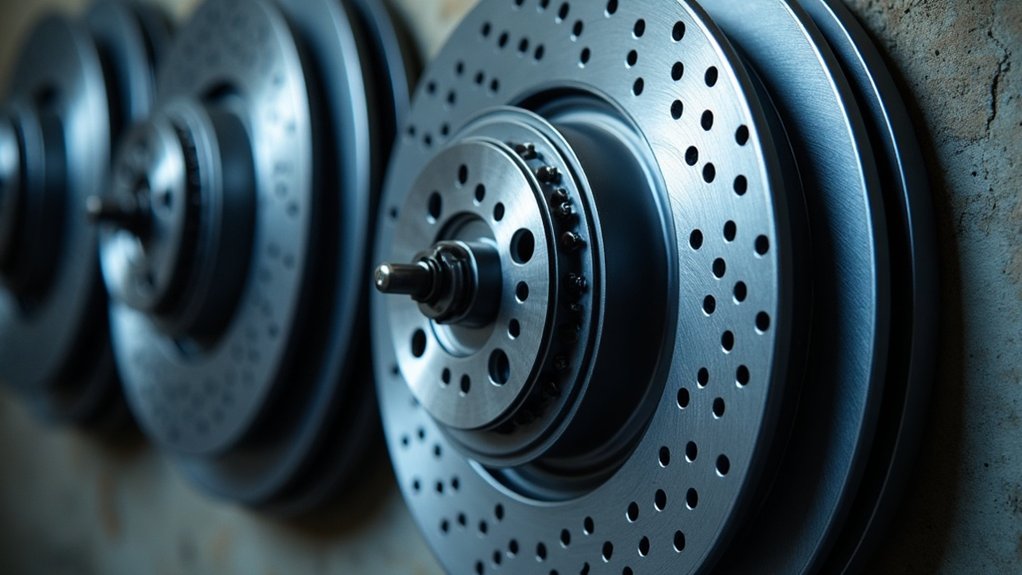
The master cylinder compresses, sending brake fluid through hydraulic lines to push the pistons against the rotors, creating friction. The sealed system protects against dirt and grit, ensuring reliable performance in all conditions.
The master cylinder compresses, sending fluid through lines to engage pistons, ensuring reliable performance by protecting against dirt and grit.
With less hand effort required, you experience reduced fatigue and excellent modulation, allowing precise control over braking force.
Maintenance is infrequent, but occasional bleeding is necessary for peak performance.
Advantages of Hydraulic Disc Brakes for E-Bikes
Hydraulic disc brakes offer significant advantages for e-bike riders, especially regarding safety and performance.
These hydraulic systems provide dependable stopping power, delivering 20-30% more braking force with less hand effort than mechanical counterparts. You’ll appreciate the better control, allowing you to apply varying degrees of braking force, vital for high-performance e-bikes.
Additionally, hydraulic brakes require less maintenance compared to mechanical brakes, as they’re less prone to contamination and guarantee consistent performance in diverse conditions.
With longer-lasting brake pads and reduced adjustment needs, hydraulic disc brakes are ideal for maintaining peak braking performance, enhancing your riding experience.
The Importance of Stopping Power
Stopping power is a critical aspect of e-bike performance, especially as speeds increase. Hydraulic brakes offer superior braking force, enhancing safety by providing reliable stopping power. Their design allows for precise modulation, essential for controlling braking at high speeds. Additionally, the sealed system guarantees consistent braking performance, minimizing the effects of dirt and moisture. Hydraulic brakes effectively dissipate heat, reducing the risk of brake fade during aggressive riding, which translates to shorter stopping distances.
| Feature | Hydraulic Brakes |
|---|---|
| Braking Force | 20-30% more than mechanical brakes |
| Modulation | Precise control at high speeds |
| Brake Fade | Reduced risk during prolonged use |
| Stopping Distances | Shorter, critical for safety |
Consistent Performance in Varied Conditions
While riding an e-bike, maintaining consistent braking performance across various conditions is essential for safety and control.
Hydraulic brakes excel in providing reliable performance, particularly in wet and muddy environments, thanks to their sealed design that prevents contamination. The fluid system allows for effective heat dissipation, ensuring consistent stopping power even during prolonged braking.
Unlike mechanical systems, hydraulic brakes deliver uniform pressure across the brake pads, minimizing performance variations caused by cable stretch. They’re also less impacted by temperature fluctuations, maintaining efficiency across a wider range of conditions, which greatly enhances rider safety and control.
Maintenance and Longevity of Hydraulic Brakes
Maintaining hydraulic brakes is key to ensuring their longevity and performance. Unlike mechanical systems, hydraulic brakes require less frequent maintenance due to their sealed design, which enhances durability and promotes longer component life.
Regularly check the brake pads, ideally every 6-12 months, to maintain peak performance. The self-adjusting nature of these systems minimizes manual adjustments, providing performance consistency over time.
While some specialized tools may be necessary for maintenance, the longer lifespan of hydraulic brake pads—averaging 800-1600 kilometers—can result in lower long-term costs.
Prioritizing maintenance will keep your hydraulic brakes performing at their best.
Enhanced Modulation and Control
Because hydraulic brakes are designed for superior modulation, you’ll find they allow for precise control over braking force with minimal effort. This enhanced modulation is essential for maintaining control at high speeds, especially on varied terrains.
- Hydraulic brakes provide consistent performance, even in wet or muddy conditions.
- Reduced hand fatigue leads to better control during long rides.
- Smooth engagement prevents abrupt stops, enhancing stability during rapid deceleration.
- Improved modulation helps you navigate hills and sharp turns safely.
With these features, hydraulic brakes empower you to ride confidently, making them ideal for faster e-bikes.
Choosing the Right Brake System for Your E-Bike
Selecting the right brake system for your e-bike is vital to optimizing performance and safety, especially for higher speeds.
Hydraulic brakes offer superior stopping power, delivering 20-30% more braking force with less hand effort than mechanical brakes. Their sealed design guarantees reliability, preventing dirt interference for consistent performance in various conditions.
With enhanced modulation, hydraulic systems provide better control during deceleration, essential for maintaining stability and safety. Additionally, hydraulic brakes require less frequent maintenance, making them ideal for riders focused on performance.
Although more expensive, the benefits in safety and comfort make hydraulic brakes a wise choice for high-powered e-bikes.