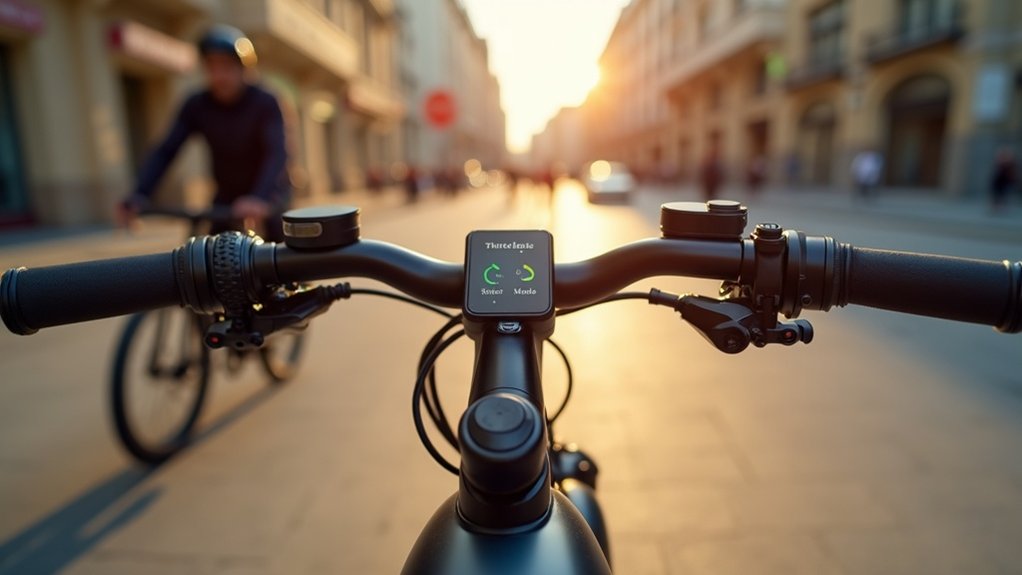
Throttle mode on an e-bike lets you engage the motor directly, delivering power instantly without pedaling. This convenient feature is perfect for those who want to navigate urban environments easily or tackle inclines and headwinds. Found typically in Class II e-bikes, throttle mode allows speeds up to 20 mph. However, be mindful that using the throttle can drain the battery faster than pedal assist. Discover more about its advantages and how it compares to other modes.
Key Takeaways
- Throttle mode allows e-bike riders to engage the motor directly without pedaling, providing immediate power and acceleration.
- It is commonly found in Class II e-bikes, which can reach speeds up to 20 mph.
- Various throttle types, such as twist throttles, offer better speed control during rides.
- Using throttle mode can drain the battery faster than pedal assist, so it’s ideal for short bursts of power.
- Throttle mode is beneficial for those with physical limitations and for navigating urban environments efficiently.
Understanding Throttle Mode: Definition and Functionality
Throttle mode on an e-bike offers an innovative way to ride without the need for constant pedaling, giving you the freedom to accelerate or maintain speed effortlessly.
By engaging the throttle, you activate the motor directly, providing an immediate boost, especially useful on inclines. Typically, these Class II e-bikes can reach 20 mph without pedaling.
You’ll find various throttle types, like twist throttles, that enhance speed control. While throttle use is convenient, it can drain battery power faster than pedal assist, so managing your throttle usage is key for longer rides.
This functionality greatly enhances your overall riding experience.
Advantages of Using Throttle Mode
When you choose to use throttle mode on your e-bike, you gain a level of convenience that enhances your riding experience considerably.
This mode provides power without the need to pedal, making it ideal for those with physical limitations or during stop-and-go traffic. Quick acceleration lets you navigate urban environments effortlessly, tackling inclines and headwinds with ease.
Throttle mode also allows you to conserve battery life by switching between throttle and pedal assist settings based on your needs.
Throttle mode enables efficient battery conservation by seamlessly toggling between throttle and pedal assist, tailored to your riding needs.
Ultimately, it offers better control over speed, allowing you to enjoy the ride at a relaxed pace while exploring scenic routes.
Throttle vs. Pedal Assist: Key Differences
Choosing between throttle mode and pedal assist is pivotal for optimizing your e-bike experience.
Throttle mode lets you engage the motor instantly without pedaling, offering full control over speed and power, making it ideal for various terrains. In contrast, pedal assist requires your input, utilizing torque sensors to adjust motor support based on your pedaling effort.
While both modes can reach speeds up to 20 mph, throttle usage can drain the battery quicker due to its on-demand power.
Pedal assist promotes better battery efficiency by encouraging riding, making it a more sustainable option for longer journeys.
Considerations When Choosing a Throttle E-Bike
As you explore the world of e-bikes, it’s essential to contemplate several factors that can enhance your riding experience with a throttle-equipped model.
Consider these key aspects:
- Control features that allow easy switching between throttle and pedal assist for versatility.
- Customizable battery modes that optimize power based on terrain, ensuring efficiency during rides.
- Robust safety features like responsive brakes and durable tires for a safer journey.
Additionally, prioritize frame stability for confidence at higher speeds and check local regulations, as they can impact where and how you can ride your throttle e-bike.
Legal Aspects of Riding Throttle-Controlled E-Bikes
Understanding the legal aspects of riding throttle-controlled e-bikes is vital for every rider.
Classified as Class II, these e-bikes let you engage the motor without pedaling, with a maximum speed limit of 20 mph. However, local regulations vary considerably, so you must check your area’s specific laws for compliance.
Unlike Class I and Class III e-bikes, which have different legal restrictions, throttle-controlled models may face additional requirements, like needing a speedometer or having riding area restrictions.
Staying informed about evolving e-bike laws is essential for your safety and legality while enjoying your ride.