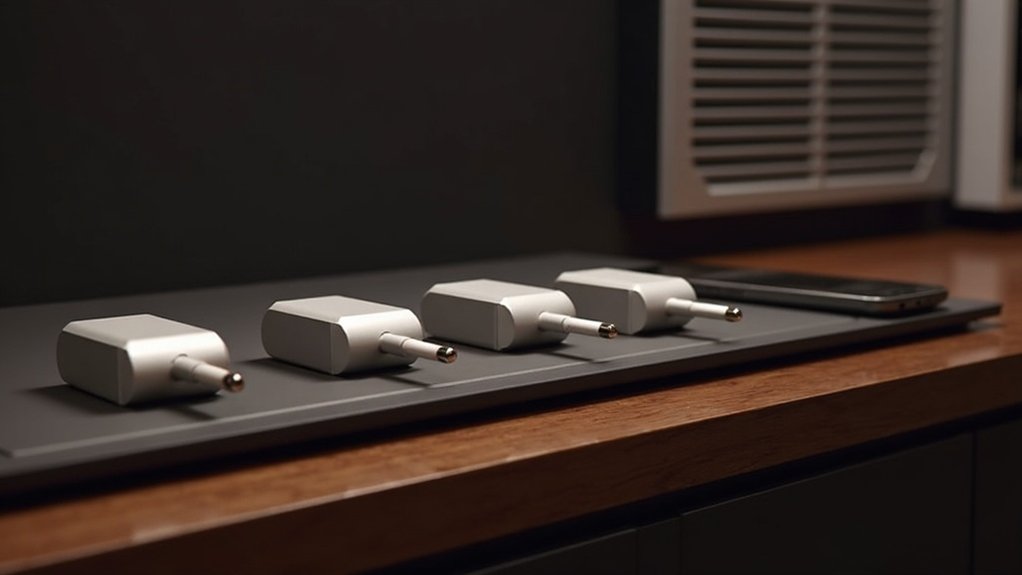
To prevent heat buildup while charging, maintain at least 12 inches of space between chargers and guarantee a minimum of 6 inches for airflow. Placing chargers on hard, flat surfaces is essential to avoid ventilation restrictions. Consider wall-mounted or vertically arranged chargers to enhance airflow. Also, monitor temperatures regularly to prevent overheating. By following these guidelines, you can optimize charger performance and safety. Explore more strategies for effective charger arrangements to enhance your charging setup’s efficiency.
Key Takeaways
- Maintain a minimum distance of 12 inches between chargers to ensure adequate airflow and reduce heat buildup.
- Position chargers 1 to 2 feet apart for optimal ventilation and safety.
- Avoid placing chargers on soft surfaces that restrict airflow and promote overheating.
- Regularly inspect and rearrange chargers to prevent overcrowding and maintain performance.
- Use dedicated wall mounts to elevate chargers and keep them away from heat-retaining surfaces.
Importance of Proper Charger Spacing
When you don’t space chargers properly, you risk heat buildup that can lead to overheating and potentially dangerous situations. Proper charger spacing is vital for guaranteeing adequate airflow, which promotes effective heat dissipation.
A minimum distance of 12 inches between chargers is necessary to facilitate proper ventilation and reduce heat accumulation. Avoid placing chargers in enclosed spaces or stacking them, as this greatly increases the risk of overheating.
Additionally, using chargers with built-in cooling systems can enhance safety. Regularly inspecting and rearranging your chargers confirms they’ve sufficient space, prolonging their lifespan and maintaining peak performance while prioritizing charger safety.
Recommended Distance Between Chargers
Maintaining a distance of 1 to 2 feet between chargers is essential for guaranteeing adequate airflow and preventing heat buildup. This spacing allows for proper airflow, greatly reducing the risk of overheating, especially in high ambient temperatures.
If you’re using multiple charging stations, consider wall-mounted or vertically spaced chargers to optimize air circulation. Regularly monitor the temperature of chargers to guarantee they stay below 40° C (104° F).
Utilizing charging stations with built-in cooling features can further enhance airflow and temperature regulation. Prioritizing these distances safeguards your equipment while promoting efficient charging performance.
Effects of Heat Buildup on Charging Efficiency
Heat buildup greatly impacts charging efficiency, as elevated temperatures create higher electrical resistance in wires. This results in energy loss during transfer and can lead high-quality chargers to throttle their output to prevent overheating. Consequently, you’ll experience slower charging times for your devices.
Operating chargers at high temperatures can degrade internal components, further diminishing performance and lifespan. Additionally, increased thermal conditions may push devices into thermal protection modes, halting charging until temperatures drop.
To maintain ideal charging efficiency and prevent these issues, guarantee adequate airflow by properly spacing chargers, allowing heat to dissipate effectively.
Utilizing Ventilation and Heat Sinks
To prevent heat buildup, you must prioritize airflow around your chargers by ensuring adequate spacing and ventilation.
Integrating heat sinks can enhance heat dissipation, while strategic charger placement away from direct sunlight and heat sources further mitigates overheating risks.
Regular maintenance of ventilation systems is essential, as it keeps airflow ideal and supports safe operating temperatures.
Importance of Airflow
Effective airflow is vital for preventing heat buildup in chargers, as it directly impacts the efficiency and safety of the charging process.
Proper spacing between chargers creates optimal airflow, minimizing the risk of overheating. Ventilation systems, like fans or open-air designs, enhance air circulation, ensuring that hot air doesn’t accumulate around charger components.
Strategically placing chargers in well-ventilated areas promotes natural airflow, further cooling the units. Maintaining an adequate distance—ideally a few inches—between chargers allows each device to operate efficiently, reducing interference and promoting effective heat dissipation.
Prioritizing airflow is essential for reliable and safe charging.
Heat Sink Integration
While integrating heat sinks into charger designs greatly enhances thermal management, it’s essential to guarantee that adequate ventilation accompanies this feature. Proper airflow reduces heat buildup, ensuring efficient heat dissipation during charging sessions. Here’s a concise overview of effective heat sink integration:
| Heat Sink Material | Thermal Conductivity | Cooling Mechanism |
|---|---|---|
| Aluminum | High | Passive Cooling |
| Copper | Very High | Active Cooling (Fan) |
Utilizing high-conductivity materials and ensuring adequate spacing between chargers promotes ideal thermal transfer, extending service life and preventing overheating during operation.
Charger Placement Strategies
Three key strategies can greatly enhance charger placement to prevent heat buildup and improve efficiency.
First, make sure chargers are spaced a few inches apart to facilitate airflow, minimizing heat buildup from adjacent units.
Second, install chargers in well-ventilated areas where ambient temperatures are lower, promoting natural air circulation and reducing overheating risks. Avoid placing chargers on soft surfaces, like carpets, as they obstruct airflow and trap heat.
Finally, consider using cooling fans or ventilation systems to actively circulate air around chargers, further diminishing the chances of heat buildup and maintaining ideal operating temperatures during use.
Common Mistakes to Avoid When Spacing Chargers
When spacing chargers, you must avoid common mistakes that can lead to heat buildup.
Ignoring ventilation needs, overcrowding charging stations, and neglecting temperature monitoring can greatly increase the risk of overheating.
Ignoring Ventilation Needs
Ignoring ventilation needs can substantially compromise the performance and safety of your chargers. Insufficient spacing restricts airflow, leading to heat buildup and the risk of overheating during prolonged use.
Chargers should be spaced at least 12 inches apart to facilitate proper ventilation and mitigate electrical safety risks. Avoid placing chargers in enclosed or poorly ventilated areas, as this exacerbates temperature issues, increasing the likelihood of failure or fire hazards.
Always adhere to the manufacturer’s recommendations for spacing and installation. Regularly inspect charger placements to verify no obstructions block airflow, as even minor blockages can considerably hinder cooling effectiveness.
Overcrowding Charging Stations
Overcrowding charging stations can considerably hinder the performance and safety of your chargers, as restricted airflow leads to heat buildup. To prevent overheating, maintain at least three feet of space between chargers, ensuring adequate ventilation.
- Overloaded circuits can damage your equipment.
- Insufficient airflow may lead to premature charger failure.
- Direct sunlight exposure increases operating temperatures.
- Improper spacing can result in safety hazards.
Distributing chargers across separate circuits balances the load, while wall-mounted installations enhance airflow.
Prioritize proper spacing to protect your investment and maintain efficient charging stations.
Neglecting Temperature Monitoring
Proper spacing alone doesn’t guarantee safety and efficiency; neglecting temperature monitoring can exacerbate overheating risks.
Without active temperature monitoring, you might overlook critical heat buildup, increasing fire hazards and equipment damage.
Overcrowding chargers limits air circulation, trapping heat and compromising performance.
It’s essential to utilize chargers with built-in safety features that track temperature thresholds.
Ignoring the manufacturer’s spatial guidelines for installation can lead to inefficient heat dissipation, making overheating far more likely.
Prioritizing temperature monitoring alongside proper spacing secures ideal airflow and mitigates risks, safeguarding both your devices and the surrounding environment during charging operations.
Monitoring Charger Temperatures
To prevent potential hazards associated with overheating, it’s essential to regularly monitor charger temperatures during their operation.
Regularly monitoring charger temperatures is crucial to avoid hazards linked to overheating during use.
Implementing effective strategies can safeguard your devices and environment:
- Overheating chargers can lead to fire hazards.
- Real-time temperature monitoring features enhance safety.
- AI-powered software can automate alerts to prevent overheating.
- Keeping chargers in well-ventilated areas promotes adequate airflow.
Best Practices for Charger Arrangement
Effective charger arrangement is key to maintaining ideal performance and safety.
Make sure at least 6 inches of space between chargers to promote airflow and prevent heat buildup. Avoid placing chargers on soft surfaces, as these restrict ventilation and can lead to overheating.
Instead, install chargers in well-ventilated areas, preferably using dedicated wall mounts that elevate them away from heat-retaining surfaces.
Consider charging stations with built-in cooling features for better heat management.
Finally, regularly monitor the temperature of your chargers, and rearrange them if you notice any signs of overheating, such as excessive warmth or discomfort to touch.