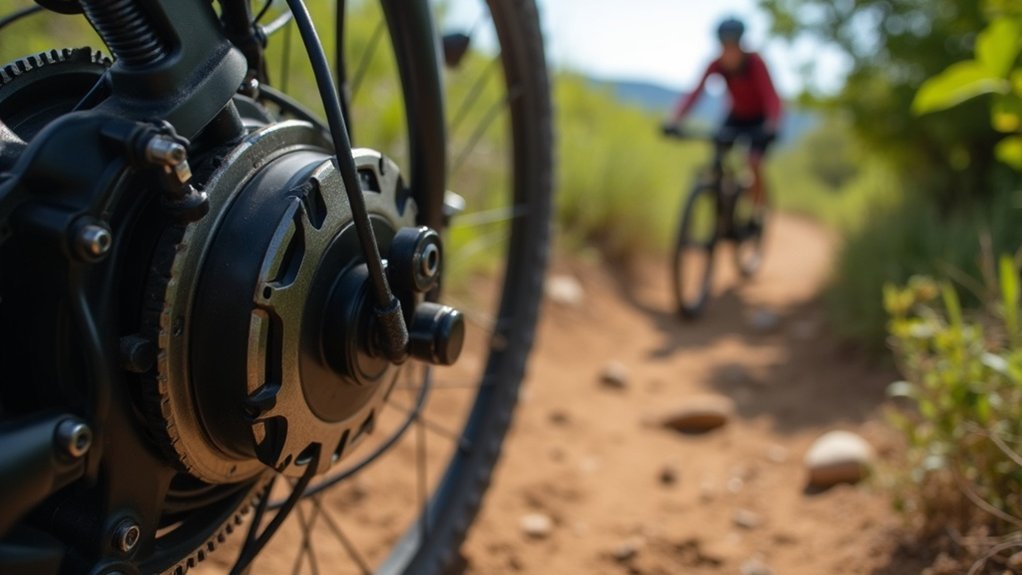
E-bike motor wattage alone doesn’t capture the full performance picture. While higher wattage might seem better, it’s the continuous power, torque, and system efficiency that truly impact your ride. Torque affects acceleration and climbing ability more than wattage does, and peak power can mislead if continuous output isn’t strong. Additionally, factors like voltage architecture and controller tuning enhance the overall experience. You’ll discover more about these essential aspects beyond just the numbers.
Key Takeaways
- Continuous power is more important than peak wattage for real-world riding, especially in urban environments where sustained output matters.
- Torque, not just wattage, significantly affects acceleration and climbing ability, influencing overall performance.
- Mid-drive motors can achieve higher speeds and better efficiency than hub motors at lower wattages.
- Higher voltage systems enhance power delivery and efficiency, affecting performance beyond just wattage ratings.
- Controller tuning can optimize motor performance, making a lower-wattage motor outperform a higher-wattage system in practical scenarios.
Understanding the Basics of E-Bike Wattage
When you’re diving into the world of e-bikes, understanding wattage is crucial for making informed choices about your ride.
Wattage measures the power output of the motor, with nominal wattage indicating sustained performance. A 750W motor can vary in continuous power due to controller settings and brand differences.
Torque, measured in Newton-meters, greatly impacts your acceleration and climbing ability, often overshadowing wattage alone.
Additionally, mid-drive motors typically achieve higher speeds with less wattage than hub motors.
To optimize e-bike power, verify your battery size aligns with the motor’s wattage for a seamless, efficient riding experience.
The Difference Between Peak Power and Continuous Power
When you evaluate an ebike’s performance, it’s essential to understand the difference between peak power and continuous power.
Peak power may impress with its short bursts, but continuous power is what truly impacts your ride quality and efficiency over longer trips.
Understanding Power Ratings
Understanding the difference between Peak Power and Continuous Power is essential for evaluating e-bike motor performance, especially since these ratings can greatly impact your riding experience.
Peak Power represents the maximum motor wattage achieved in short bursts, while Continuous Power indicates the sustained output a motor reliably delivers over time. This distinction is significant for performance comparisons, as a motor with high Peak Power may not offer a better experience if its Continuous Power is low.
Additionally, factors like RPM and environmental conditions can influence actual power and torque measured, affecting your e-bike’s overall performance on the road.
Real-World Performance Differences
While you may be tempted to focus solely on a motor’s peak power rating when choosing an e-bike, it’s vital to take into account how continuous power impacts your actual riding experience.
Consider these factors:
- Real-world usage: Continuous power reflects everyday performance, important for urban areas.
- Watt rating: A 1000W peak motor may only deliver 750W continuously.
- Higher torque: Motors with better continuous power maintain performance during climbs.
- RPM variation: Continuous power effectiveness can fluctuate based on RPM.
Understanding eBike motor performance means looking beyond peak power for a truly satisfying ride.
The Importance of Torque in E-Bike Performance
Torque plays a pivotal role in e-bike performance, especially when it comes to acceleration and climbing steep hills.
Measured in Newton-meters (Nm), torque determines how effectively your e-bike can launch and tackle inclines. For instance, a motor with 110 Nm of torque will outperform one with 80 Nm, even at the same 750W rating.
Torque, measured in Newton-meters (Nm), directly influences your e-bike’s launching power and climbing ability.
This higher torque translates to better real-world power, enhancing your riding experience in urban settings or varied terrains.
Unlike wattage, which reflects power consumption, torque directly affects your e-bike’s ability to accelerate quickly and navigate challenging inclines, making it an essential factor in your choice.
Voltage Architecture: Enhancing Power Efficiency
When you consider voltage architecture in e-bikes, higher voltage systems like 60V can greatly impact power delivery efficiency.
These systems maintain speed better under load and during climbs, allowing for smoother throttle response without the drawbacks of increased current.
Higher Voltage Benefits
As you explore the benefits of higher voltage systems in e-bikes, it’s essential to understand how a 60V architecture can enhance power efficiency.
Here are a few key advantages:
- Consistent power delivery with lower current draw.
- Higher peak performance under load, especially on climbs.
- Efficient power usage, reducing heat buildup during rides.
- Improved throttle feel and hill control, enhancing your overall experience.
Transitioning to a 60V system not only boosts your ride’s performance consistency but also guarantees you maintain speed and efficiency in various conditions, making your e-bike experience more enjoyable and powerful.
Power Delivery Efficiency
Understanding power delivery efficiency in e-bikes hinges on the interplay between voltage and current, which greatly influences your riding experience.
Higher voltage systems, like 60V, deliver more watt motors efficiently at lower currents, reducing heat buildup and enhancing performance. This allows you to maintain peak power during long rides or climbs, ensuring a responsive ride under load.
With mid drives, higher voltage also enhances torque delivery, preventing it from tapering off quickly.
The Role of Controller Tuning in Motor Performance
While many riders focus on motor wattage as the primary indicator of performance, the role of controller tuning is equally essential in optimizing an e-bike’s capabilities.
Effective tuning guarantees:
- Enhanced motor efficiency, maximizing torque delivery.
- Improved peak power, outperforming higher-wattage systems.
- Better thermal management, preventing overheating during demanding rides.
- Consistent power output, especially on climbs with advanced controllers.
Ultimately, a well-tuned controller can considerably elevate your riding experience, making it clear that wattage alone doesn’t define performance.
A finely tuned controller significantly enhances your ride, proving that performance goes beyond mere wattage.
Emphasizing controller tuning allows you to harness your e-bike’s true potential and enjoy smoother, more powerful rides.
Real-World Riding Experience: Beyond the Numbers
Motor wattage figures can paint an impressive picture, but they often don’t tell the full story of your e-bike’s performance on the road.
While peak wattage is flashy, torque plays an essential role in real-world riding. A 750W motor with high torque delivers responsive acceleration, especially when climbing hills, compared to a 1000W motor with lower torque.
Additionally, higher voltage systems enhance power delivery, maintaining speed under load. Real-world conditions, like terrain and weight, further influence performance.
To truly understand your electric bike’s capabilities, consider these factors beyond just wattage and test different models for the best experience.