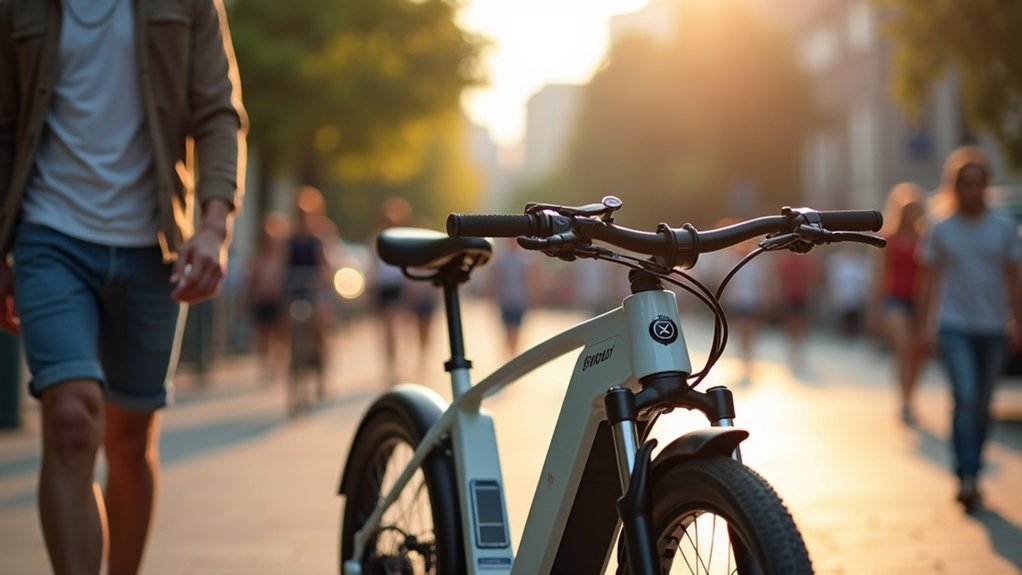
E-bikes include walk assist mode to help you navigate tough terrains and tight spaces with ease. It allows your bike to move alongside you at low speeds, reducing physical strain and enhancing safety. This feature comes in handy when dealing with heavy loads or maneuvering through crowded areas. While it offers great benefits, there are also limitations to take into account. If you’re curious about how this technology works and its future, stick around for more insights.
Key Takeaways
- Walk Assist Mode allows e-bikes to move alongside riders at low speeds, easing navigation in tight spaces and steep inclines.
- It reduces physical strain when pushing heavy bikes, making it easier to maneuver during challenging situations.
- The mode enhances safety during low-speed maneuvers, providing better control in crowded or technical areas.
- It assists in transporting bikes during mechanical issues or emergencies, such as flat tires, simplifying maintenance tasks.
- Future developments aim to improve Walk Assist functionality with smarter sensors and enhanced battery technology for a better user experience.
Understanding Walk Assist Mode
When you’re maneuvering tight spaces or tackling steep inclines, understanding walk assist mode can greatly enhance your riding experience.
This feature allows your electric bike to move alongside you at a low speed, typically around 4 mph, thanks to motor assist. Activation methods differ by model, often requiring you to press a specific button while in assist mode 0.
This feature enables your electric bike to glide beside you at a gentle speed of about 4 mph with motor assistance.
Walk assist is invaluable for traversing obstacles like stairs and rutted trails. Additionally, its safety features minimize unintended acceleration, ensuring you maintain control during these low-speed maneuvers.
Some riders find it essential, while others prefer throttle control for similar challenges.
Benefits of Walk Assist Mode
While traversing challenging terrains or managing heavy loads, walk assist mode on e-bikes offers numerous advantages that can enhance your riding experience. This feature provides power, allowing your bike to move alongside you at a controlled speed of around 4 mph.
This capability considerably reduces physical strain when pushing a fully loaded bike up stairs or uneven trails. It also enhances safety by minimizing risks associated with losing control.
In emergencies, such as flat tires, walk assist mode makes transporting your bike effortless. Regular use can aid maintenance tasks, like chain lubrication, by letting you slowly spin the wheels while keeping the bike stationary.
Common Use Cases for Walk Assist
Walk assist mode proves invaluable in various scenarios, making it an essential feature for e-bike users.
You’ll find it especially handy in situations like:
- Maneuvering through unrideable terrain, such as steep hills or sandy beaches, with minimal strain.
- Carrying heavy loads, like groceries, up ramps or stairs where riding isn’t possible.
- Transporting your bike during mechanical failures, such as flat tires, making the trip home easier.
- Enhancing safety in crowded areas or technical trails, preventing accidents with low-speed assistance.
With this motor power at your fingertips, walk mode transforms the way you interact with your electric bike.
How Walk Assist Mode Works
Understanding how walk assist mode operates can greatly enhance your e-bike experience.
When activated, this mode allows your bike to move at a slow speed of about 3.5 to 6 km/h while you walk alongside. You typically engage walk mode by holding down a specific button on the display, like the Minus (-) button or a dedicated walk assist button.
Some models even show a walking symbol, confirming activation. This low power assistance makes it easier to navigate obstacles, reducing your physical strain.
Depending on the model, you might also adjust the speed, tailoring the assistance to your needs.
User Experiences With Walk Assist
User feedback on walk assist mode highlights a mix of appreciation and challenges associated with its use.
Many riders find the ebikes walk mode beneficial, especially when:
- Maneuvering up steep inclines or tough terrain
- Alleviating physical strain while transporting heavy loads
- Guiding around obstacles with enhanced control
- Using it in emergencies, like flat tires
However, some users complain about the inconvenience of holding the activation button while walking alongside.
Others prefer throttle control for a more comfortable experience.
Limitations of Walk Assist Mode
While walk assist mode can be a helpful feature, it comes with its own set of limitations.
You might find the speed too slow for practical use, especially if you’re on a flat surface or need to navigate quickly.
Additionally, maintaining pressure on the activation button can be tricky, making it hard to manage your bike effectively.
Activation Challenges
Although walk assist mode can enhance the experience of maneuvering on an e-bike, it comes with notable activation challenges that many riders encounter.
These issues can limit the practicality of walk assist:
- Holding the button while walking can be inconvenient.
- The speed often stays at 6 km/h if the button isn’t continuously pressed.
- Balancing button pressure and handlebars may hinder effective use.
- Variability in bike design and programming impacts ease of activation.
These activation challenges can frustrate riders who expect smooth operation from their e-bikes, emphasizing the importance of compatible displays and controls for an ideal experience.
Speed Control Issues
Speed control in walk assist mode often leaves riders grappling with limitations that can hinder their overall experience.
For instance, the walk speed is typically capped at around 4 mph, which might feel too slow in certain situations. Maintaining consistent pressure on the button can be tricky, especially if you’ve used the throttle for a quick boost.
Some models limit walk assist to just 2.5 mph to guarantee safety, but that may not align with your needs.
Additionally, if the bike’s motor doesn’t engage properly, the walk assist becomes frustratingly ineffective, leading to overall dissatisfaction.
Future Developments in E-Bike Technology
As e-bike technology continues to evolve, future developments are set to considerably enhance the walk assist mode, making it more intuitive and user-friendly.
You can expect advancements that include:
- Smarter sensors adapting speed based on terrain and user behavior
- Enhanced battery technology for efficient power management
- Artificial intelligence learning user preferences for personalized experiences
- Improved safety features, like automatic shut-off systems
These innovations won’t only power the bike more effectively but also guarantee a safer and more enjoyable ride.
With real-time diagnostics, you’ll have ideal control over your walk assist functionality, making every journey smoother.