
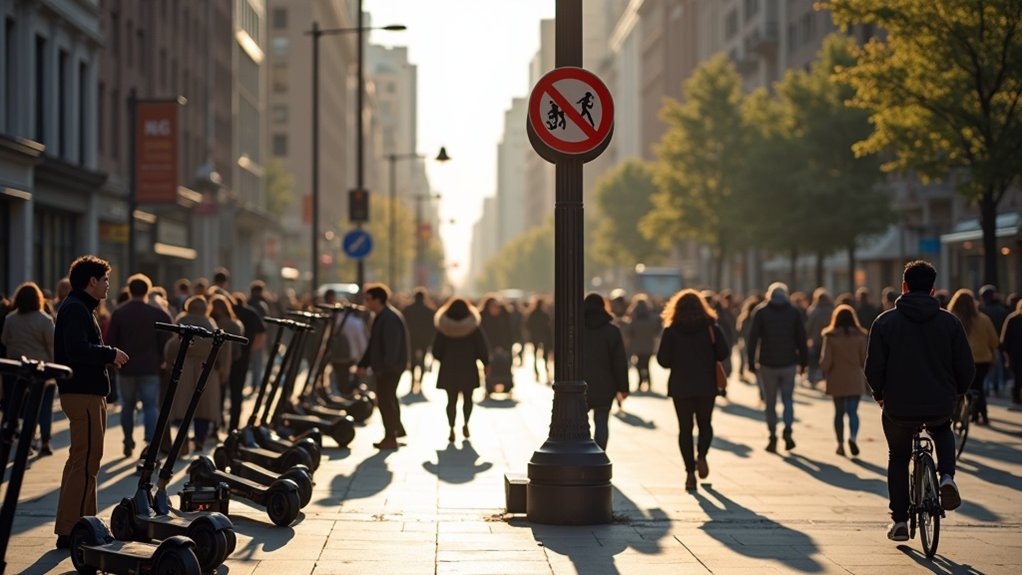
Many cities restrict e-scooters on sidewalks to protect pedestrians, especially vulnerable groups like children and the elderly. These regulations help reduce collision risks stemming from unpredictable rider movements in crowded areas. With sidewalks often too narrow for both pedestrians and scooters, safety becomes a pressing concern. Local governments can impose stricter rules than state laws to guarantee safer urban environments. Understanding these regulations and their impact is essential for fostering safer streets for everyone. You’ll discover more about the intricacies of these measures ahead.
Key Takeaways
- E-scooters can reach high speeds, increasing the risk of accidents for pedestrians, especially vulnerable populations like children and the elderly.
- Most e-scooter injuries occur on sidewalks, prompting cities to restrict riding to enhance pedestrian safety.
- Sidewalks often lack sufficient width for both e-scooters and pedestrians, leading to congestion and heightened safety risks.
- Local governments can impose stricter regulations than state laws, aiming to better protect pedestrians from potential collisions with e-scooters.
- Advocating for dedicated bike lanes and multi-use paths can promote safety for both e-scooter riders and pedestrians, reducing sidewalk conflicts.
Pedestrian Safety Concerns
As cities embrace the rise of e-scooters, it’s crucial to recognize the safety concerns that arise for pedestrians.
Electric scooters can reach high speeds, posing serious risks, especially to vulnerable populations like children and the elderly.
Studies reveal that most e-scooter injuries occur on sidewalks, where unpredictable movements from scooter riders endanger pedestrians.
Local laws in cities like San Francisco and Los Angeles address these risks by restricting riding on sidewalks, aiming to prevent collisions and serious injuries.
Limitations of Sidewalk Infrastructure
As you consider the limitations of sidewalk infrastructure, it’s clear that many sidewalks lack the necessary width to safely accommodate both pedestrians and e-scooters.
This congestion not only heightens safety risks but also complicates urban design efforts aimed at promoting accessibility for all users.
Addressing these challenges is essential for developing effective policies that balance the needs of e-scooter riders with pedestrian safety.
Sidewalk Width Constraints
While many cities embrace e-scooters as a sustainable transportation option, the limitations of sidewalk infrastructure pose significant challenges for their safe integration.
Narrow sidewalks primarily designed for pedestrian traffic can lead to accidents, as overcrowding makes navigation difficult for both pedestrians and scooter riders. Local regulations often address these concerns, but existing scooter laws may not adequately guarantee safety.
The Americans with Disabilities Act mandates accessibility, yet e-scooters can obstruct pathways, complicating the riding experience for those with disabilities.
Addressing sidewalk width constraints is essential to balance pedestrian safety and the growing demand for e-scooter access in urban areas.
Pedestrian Safety Concerns
Narrow sidewalks not only challenge e-scooter integration but also exacerbate pedestrian safety concerns. The presence of e-scooters increases the risk of collisions, particularly in crowded areas where vulnerable populations—like the elderly and children—navigate. Many sidewalks aren’t built to handle such speeds, leading to accidents on uneven surfaces. As reports of pedestrian injuries rise with e-scooter usage, local governments impose stricter regulations on sidewalk riding to safeguard everyone.
| Issue | Impact on Pedestrians | Regulatory Response |
|---|---|---|
| Increased Collisions | Higher injury rates | Restrictions on use |
| Speed Disparity | Fear among vulnerable | Defined riding zones |
| Uneven Surfaces | Accidents | Infrastructure upgrades |
Urban Design Limitations
Urban areas often struggle with sidewalk infrastructure that’s ill-equipped to handle the increasing presence of e-scooters. These design limitations can lead to significant safety issues and congestion.
Consider the following:
- Sidewalks prioritize pedestrian traffic, often neglecting e-scooter speed and weight.
- Uneven surfaces and obstructions create hazards for scooter riders.
- Crowded areas increase the risk of accidents between e-scooters and pedestrians.
- Inadequate signage and markings contribute to confusion for both groups.
Addressing these challenges requires strategic urban planning to guarantee safety and accessibility for all users, ultimately reducing accidents and improving the overall urban experience.
State-by-State Regulations on Sidewalk Riding
As cities grapple with the rise of electric scooters, the regulations governing sidewalk riding have become a critical focus for policymakers aiming to balance accessibility and pedestrian safety.
Many states, like California and Texas, enforce state laws where sidewalk riding is banned to minimize collision risks. In contrast, Florida permits riding electric scooters in bike lanes, reflecting a lenient approach.
California and Texas prohibit sidewalk riding to enhance safety, while Florida allows electric scooters in bike lanes, showcasing differing regulatory approaches.
Meanwhile, Alabama and Arizona allow sidewalk riding under specific safety guidelines. Local governments can impose stricter scooter sidewalk laws within states, leading to significant variance.
With safety concerns driving two-thirds of U.S. communities, understanding these regulations is essential for safe riding practices.
Local Ordinances and Their Impact
While many cities recognize the growing popularity of e-scooters, the local ordinances governing their use can greatly impact rider behavior and safety.
- Local governments often impose stricter rules than state laws.
- No-sidewalk policies enhance pedestrian safety, particularly for vulnerable groups.
- Violations can lead to fines, reinforcing the importance of compliance.
- The push for bike lanes and multi-use paths aims to mitigate traffic and safety concerns.
These regulations shape how riders interact with their environments, balancing the benefits of electric scooters against potential risks on sidewalks.
Understanding these ordinances is essential for promoting safe and responsible e-scooter use.
Consequences of Violating Sidewalk Riding Laws
Failing to adhere to sidewalk riding laws can lead to significant consequences for e-scooter users.
You might face fines for riding that range from $50 to $200, depending on local regulations. Repeated violations could result in scooter rental companies immobilizing or revoking your access to scooters.
Additionally, liability for accidents that occur while riding on sidewalks typically falls on you, exposing you to legal and financial repercussions. Municipalities may also impose additional penalties for improper parking, compounding your costs.
Best Practices for Riding in Pedestrian Areas
Maneuvering pedestrian areas on an e-scooter requires a strategic approach to secure safety for everyone involved.
Navigating pedestrian zones on an e-scooter demands careful consideration to ensure the safety of all individuals present.
Here are some best practices to follow:
- Always yield to pedestrians and give them the right-of-way.
- Maintain low speed limits to secure ample reaction time for pedestrians.
- Use audible signals, like bells or verbal alerts, when passing by to increase awareness.
- In crowded pedestrian areas, dismount and walk your scooter to prevent accidents.
Advocacy for Scooter-Friendly Infrastructure
To foster a safer riding environment, advocating for scooter-friendly infrastructure is essential.
You need to push for designated lanes and improved urban mobility solutions that prioritize both scooter users and pedestrians.
Collaborating with local authorities can lead to effective policies that enhance safety and accessibility for all road users.
Promoting Safe Riding Options
As cities evolve to accommodate new forms of transportation, advocating for scooter-friendly infrastructure becomes essential for enhancing urban mobility and safety.
To promote safe riding options, consider these strategies:
- Expand bike lanes and multi-use paths for e-scooters.
- Designate specific areas for scooter use to minimize sidewalk riding.
- Implement technology like speed limiters to enforce scooter safety.
- Foster collaboration among urban planners, local governments, and communities.
Enhancing Urban Mobility Solutions
While cities increasingly embrace e-scooters as a viable transportation option, effective advocacy for scooter-friendly infrastructure is essential to guarantee these vehicles integrate seamlessly into urban mobility.
| Infrastructure Element | Benefits |
|---|---|
| Dedicated bike lanes | Reduces sidewalk conflicts |
| Multi-use paths | Enhances rider safety |
| Designated parking areas | Promotes responsible use |
Collaborating With Local Authorities
Effective collaboration with local authorities plays a pivotal role in advancing scooter-friendly infrastructure.
By actively engaging in community meetings and advocating for dedicated scooter lanes, you can enhance safety for scooter riders and pedestrians alike.
Consider these strategies:
- Join local advocacy groups to amplify community voices.
- Utilize petitions to gather public support for designated lanes.
- Partner with urban planners to explore innovative solutions.
- Advocate for policies that integrate e-scooters into existing transit systems.
Together, these actions can influence policy decisions, ensuring a safer, more accommodating environment for micro-mobility options in your city.