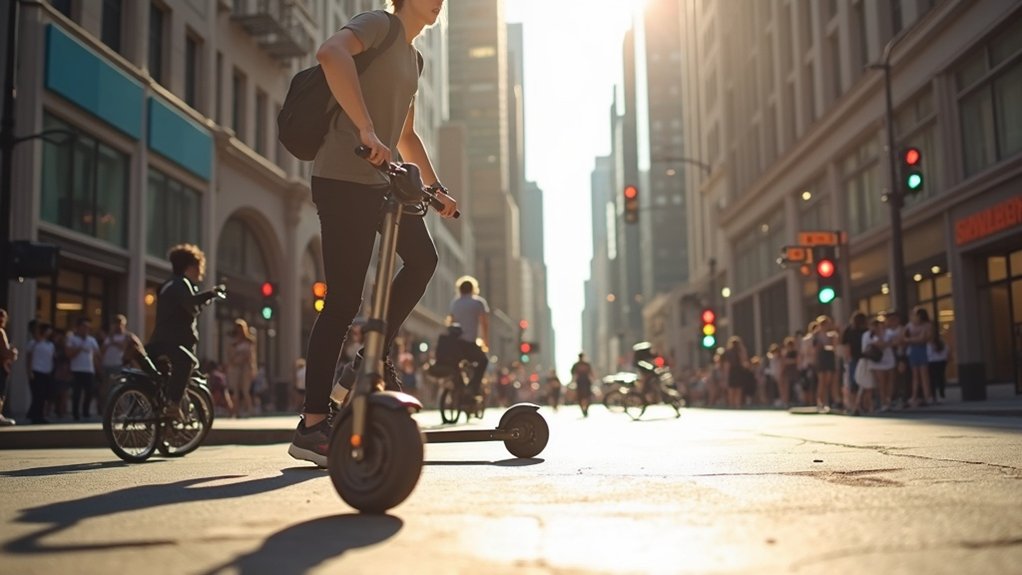
Electric scooters are allowed on the road because Texas classifies them as ‘motor-assisted scooters,’ which comply with specific legal and safety standards. They can operate on roads with speed limits of 35 mph or lower and in bike lanes. Riders must follow traffic laws, yielding to pedestrians and adhering to local regulations. This framework promotes efficient urban mobility while minimizing emissions. Want to discover more about safety regulations and the impact of e-scooters on transportation?
Key Takeaways
- Electric scooters are classified as motor-assisted scooters, making them legal for road use under Texas law.
- They are designed for urban mobility, providing an eco-friendly alternative to cars for short trips.
- Compliance with traffic laws ensures safety and promotes orderly integration into existing transportation systems.
- Local regulations may dictate specific usage rules, ensuring scooters can be safely operated alongside other vehicles and pedestrians.
- E-scooters contribute to reduced carbon emissions and improved air quality, aligning with sustainability goals in urban areas.
Understanding Electric Scooter Classification
Electric scooters are categorized as ‘motor-assisted scooters’ under Texas law, which impacts how and where you can ride them.
According to the Texas Transportation Code, these scooters must have two wheels, a reliable braking system, and a motor that doesn’t exceed 1,000 watts.
This classification allows you to operate electric scooters in Texas on public roads with speed limits of 35 mph or lower, as well as in bike lanes and shared-use paths.
Importantly, they’re exempt from registration, insurance, and licensing, but local regulations may differ, so it’s essential to know the specific rules in your area.
Legal Framework for Electric Scooters
When considering the legal framework for electric scooters, you’ll find that Texas law classifies them as motor-assisted scooters, allowing their use on public roads with certain restrictions.
Local regulations can vary considerably, impacting where and how you can ride these scooters.
Additionally, compliance with safety requirements is essential to guarantee both your safety and legal operation on the roads.
Texas Transportation Code Overview
In Texas, the legal framework governing electric scooters is outlined in the Texas Transportation Code, which classifies them as motor-assisted scooters with specific operational guidelines. You’ll find that riding electric scooters is permitted on public roads with speed limits of 35 mph or less. Here’s a quick overview of the key points:
| Aspect | Requirement | Notes |
|---|---|---|
| Speed Limits | 35 mph or less | Use designated bike lanes |
| Licensing & Registration | Not required | Different from motor vehicles |
| Compliance | Basic traffic laws apply | Yield to pedestrians |
Understanding Texas law helps guarantee safe and responsible scooter use.
Local Regulations Variations
While Texas law provides a general framework for electric scooter use, local regulations can differ widely, impacting how and where you can ride.
Each city may establish specific electric scooter laws, affecting sidewalk usage, speed limits, and helmet requirements. Some municipalities require riders to be at least 16 or 18 years old, while others emphasize yielding to pedestrians and obeying traffic laws.
This variability means you must familiarize yourself with local ordinances before hitting the road. Noncompliance could lead to penalties, making it essential to understand the unique rules governing electric scooter operation in your area.
Safety Compliance Requirements
Understanding local regulations is just the beginning; safety compliance requirements play a significant role in guaranteeing the safe operation of electric scooters.
Riders must adhere to traffic laws, including yielding to pedestrians and stopping at stop signs. In Texas, scooters need a braking system and a motor under 1,000W.
While helmets aren’t mandatory for those over 18 in Houston, wearing safety gear is highly recommended to reduce injury risks.
Additionally, local regulations may prohibit sidewalk riding in certain areas to enhance pedestrian safety. Proper parking in designated areas is essential to avoid fines and maintain responsible usage in urban environments.
Safety Regulations and Best Practices
To guarantee safety on the road, electric scooter riders must adhere to specific regulations and best practices.
First, follow the rules by obeying traffic laws, yielding to pedestrians, and stopping at stop signs. Limit your speed to a maximum of 15 mph and make sure your scooter maintains two wheels on the ground.
Enhance your visibility at night by using lights and hand signals for turns and stops.
Regular maintenance is essential; check your brakes, steering, and lights frequently to avoid mechanical failures.
Benefits of Electric Scooters for Urban Mobility
Electric scooters present an eco-friendly transportation option that effectively reduces urban congestion and lowers emissions.
Their ability to efficiently cover short distances—averaging speeds of 15-20 mph—makes them ideal for traversing city environments.
Eco-Friendly Transportation Option
As urban areas grapple with increasing congestion and pollution, electric scooters emerge as a compelling eco-friendly transportation option.
These vehicles produce zero tailpipe emissions, markedly reducing air pollution compared to traditional gasoline cars. Their compact design allows you to navigate congested streets easily, helping to alleviate traffic woes.
Studies indicate that e-scooters can replace nearly half of all short car trips, thereby lowering greenhouse gas emissions. Additionally, they consume less energy per mile than electric cars, making them a sustainable choice for urban transportation.
Integrating electric scooters into public transport can further promote multimodal solutions and greener alternatives.
Efficient Short-Distance Travel
Urban mobility is evolving, and electric scooters are at the forefront of this change, offering an efficient solution for short-distance travel.
They enable quick transit across urban areas, often surpassing cars and public transit in reducing commute times. With speeds of up to 30 mph, e-scooters navigate congested streets effectively, alleviating traffic and cutting down vehicle emissions.
Their lightweight design allows easy parking and storage, enhancing last-mile connectivity where parking is scarce. By decreasing reliance on fossil-fuel-powered vehicles, electric scooters promote sustainable urban mobility, aligning with city initiatives aimed at fostering eco-friendly transportation options.
Environmental Impact of Electric Scooters
While many transportation options contribute to air pollution and greenhouse gas emissions, electric scooters stand out for their minimal environmental footprint. They produce zero tailpipe emissions, greatly improving urban air quality.
A study reveals that e-scooters can cut carbon emissions by up to 70% for short trips compared to cars, making them a sustainable transportation choice. By replacing just 10% of car trips with electric scooter rides, we could see a notable decrease in greenhouse gas emissions, aiding climate change efforts.
Additionally, when charged from renewable energy sources, electric scooters further enhance their positive environmental impact.
Local Laws and Variations Across Cities
Understanding the local laws governing electric scooters is essential for riders, as regulations can vary widely from one city to another.
In Texas, scooters can operate on public roads with speed limits of 35 mph or less if they meet specific safety requirements. However, other cities might prohibit sidewalk riding or impose age restrictions, such as a minimum age of 16.
Cities like Austin allow sidewalk riding, while Los Angeles and New York City enforce stricter rules. Compliance with local laws is critical, as violations can lead to fines, making it important to stay informed about evolving regulations.
Challenges and Controversies Surrounding E-Scooters
As cities embrace the growing trend of electric scooters, they face a myriad of challenges and controversies that complicate their integration into urban environments.
Safety concerns have surged, with reported injuries skyrocketing from 8,566 in 2017 to over 56,000 by 2022.
Varied local regulations contribute to confusion, especially regarding sidewalk riding, which can endanger both riders and pedestrians.
The absence of insurance and registration raises accountability issues in accidents.
Additionally, careless parking often obstructs sidewalks, prompting community complaints and demands for stricter regulations.
Balancing these challenges while promoting safety remains a critical task for urban planners and policymakers.
The Future of Electric Scooters on the Road
With cities increasingly recognizing the potential of electric scooters as a sustainable transportation solution, their future on the road looks promising. As regulations evolve to enhance safety features, you’ll likely see more designated parking zones and helmet laws. The integration of e-scooters into public transportation systems will provide convenient first-mile/last-mile options, reducing congestion. With the global e-scooter market projected to exceed $41 billion by 2028, investments in infrastructure like bike lanes are expected to grow.
| Aspect | Future Outlook |
|---|---|
| Market Growth | Over $41 billion by 2028 |
| Safety Regulations | Helmet laws and parking zones |
| Infrastructure | More bike lanes and paths |
| Technology | GPS tracking and enhanced features |
| Public Transit | Integration into existing systems |