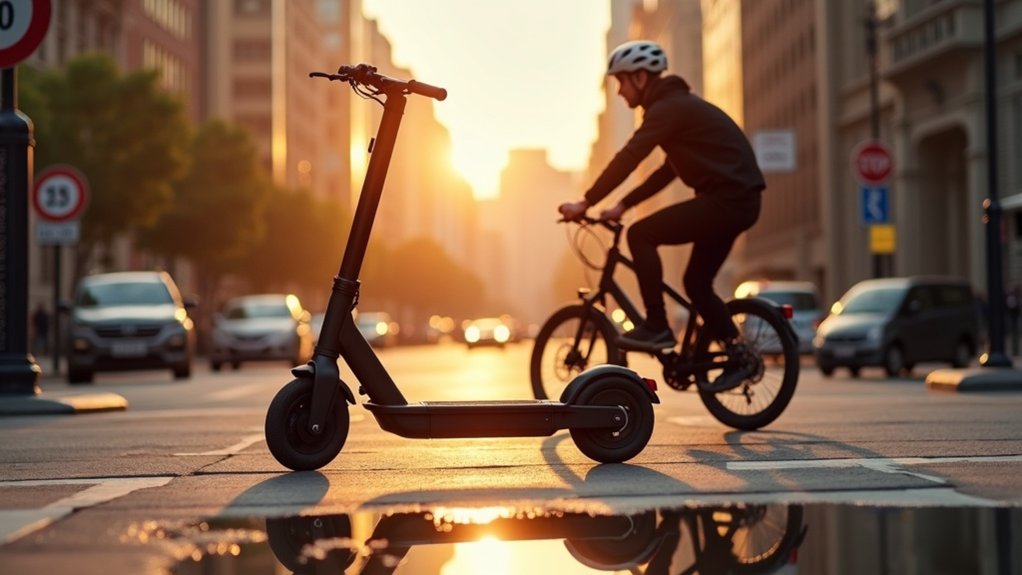
E-scooters are often limited to specific speeds to prioritize your safety and that of pedestrians. Local laws usually cap speeds between 15 to 20 mph, minimizing accident risks and enhancing control. These limits also protect the scooter’s battery and motor while ensuring compliance with safety standards. Manufacturers play an essential role by integrating speed limiters. Understanding these regulations and their impacts can help you make informed choices on your riding experience. There’s more to explore on this topic.
Key Takeaways
- Speed limits for e-scooters enhance rider safety by reducing the risk of accidents and severe injuries in urban environments.
- Local regulations typically cap speeds between 15-20 mph to prioritize safety and mitigate conflicts with pedestrians.
- Helmet requirements for younger riders are enforced to prevent head injuries, promoting safe riding practices.
- Manufacturers integrate speed limiters to comply with safety standards and ensure consistent performance without overheating.
- Terrain and rider weight affect speed capabilities, necessitating limitations to maintain stability and control.
Legal Speed Limits for Electric Scooters
As electric scooters gain popularity for urban mobility, understanding the legal speed limits imposed across various states is crucial for safe riding.
Generally, speed limits for e-scooters range from 15 to 20 mph, with some areas allowing up to 30 mph under specific conditions.
In California, you must adhere to a 15 mph limit and wear helmets if you’re under 18.
New York has similar helmet requirements and speed restrictions on public roads.
Florida mandates helmets for riders under 16 and prohibits sidewalk riding, emphasizing the importance of local laws and safety regulations to avoid fines and guarantee safe riding practices.
Safety Considerations for Riders and Pedestrians
While riding an e-scooter can be an efficient and enjoyable way to navigate city streets, it also comes with significant safety considerations for both riders and pedestrians.
Speed limits, typically set between 15-20 mph, reduce the risk of accidents and severe injuries. Regulations often mandate helmets for riders under 18, acknowledging that higher speeds increase the likelihood of head injuries.
In crowded urban environments, these limits help mitigate conflicts between e-scooter users and pedestrians. Additionally, speed regulations consider braking systems and stability, as higher speeds can compromise control and increase stopping distances, especially on uneven surfaces.
Factors Influencing Speed Limitations
E-scooter speed limitations are influenced by a variety of factors that prioritize safety, performance, and regulatory compliance. Local regulations often cap speeds between 15-20 mph to enhance rider safety and reduce accidents.
Additionally, riders’ weight and terrain can impact speed capabilities; manufacturers consider these elements to guarantee consistent performance. Speed limitations also protect the battery and motor power from overheating, which prolongs component life.
The Role of Manufacturers in Speed Regulation
Manufacturers play an essential role in regulating e-scooter speeds to guarantee compliance with safety standards and legal limits.
By incorporating speed limiters and categorizing models based on market demand, they balance performance with rider safety.
As concerns over injuries rise, their design choices increasingly reflect a commitment to safer urban mobility solutions.
Safety Standards Compliance
To navigate the complex landscape of safety regulations, manufacturers play an essential role in establishing and enforcing speed limitations for electric scooters. Compliance with safety standards, shaped by local regulations, guarantees that scooter speeds stay within 15-20 mph, minimizing accident risks. Speed limiters are integral features that prevent exceeding these legal thresholds, enhancing consumer safety. Rigorous design and testing processes confirm that scooters meet maximum speed requirements, directly impacting marketability. Ultimately, effective manufacturers compliance not only fosters injury prevention but also aligns with consumer demand for safety features, reinforcing the importance of responsible speed regulation.
| Safety Feature | Purpose | Impact on Compliance |
|---|---|---|
| Speed Limiters | Restricts scooter speeds | Prevents legal issues |
| Design Protocols | Guarantees safety standards | Enhances injury prevention |
| Testing Procedures | Validates compliance | Increases consumer trust |
| Local Regulations | Guides speed limits | Reduces accident risks |
Legal Speed Limits
While steering through the regulations surrounding electric scooters, understanding legal speed limits is essential for both manufacturers and riders. Many jurisdictions impose speed limits ranging from 15 to 30 mph, compelling manufacturers to integrate speed limiters for compliance.
For instance, California and New York enforce a maximum speed of 15 mph to enhance rider safety in urban commuting. Manufacturers tailor scooters’ motor power and specifications to meet these legal requirements, ensuring the models align with intended use.
Compliance with these speed regulations not only protects riders from accidents but also helps manufacturers avoid legal repercussions associated with exceeding established limits.
Market Demand Influence
E-scooter speed regulation is greatly influenced by market demand, shaping how manufacturers approach design and functionality. As consumer preferences shift towards safety, manufacturers often limit scooter speed to comply with local speed regulations, typically capping it between 15-20 mph.
The average urban commuter favors reliable speeds of 15-30 mph, prompting a focus on performance and safety rather than sheer speed. Built-in speed limiters help mitigate liability and enhance user safety, especially for inexperienced riders.
Product differentiation allows manufacturers to cater to diverse segments, offering various models that balance speed and safety, appealing to both casual riders and speed enthusiasts.
Impact of Riding Conditions on Speed
Riding conditions can greatly influence the speed of electric scooters, as various factors like road surface quality, incline, and weather play critical roles.
Smooth pavement allows you to achieve up to 100% of the maximum speed, while rough roads can cause a significant speed reduction to 70-80%. Steeper inclines challenge most scooters, often limiting performance.
Smooth pavement maximizes speed, while rough roads can cut it down to 70-80%, and steep inclines further limit performance.
Weather conditions, especially cold temperatures, can decrease speeds by 10-30% due to battery resistance. Additionally, rider weight affects acceleration and top speed; exceeding weight limits can reduce speed by 1-2 mph for every 20 pounds.
Battery charge levels below 50% can also lead to speed drops.
Technological Solutions to Enhance Safety
When you ride an electric scooter, built-in speed limiters play an essential role in keeping you safe by capping speeds at 15-20 mph.
Enhanced braking systems, such as regenerative and hydraulic disc brakes, guarantee you can stop effectively, maintaining control even at higher speeds.
These technological solutions work together to create a safer riding experience, especially in urban environments.
Speed Limiters Implementation
To enhance safety on public roads, speed limiters are now standard features in electric scooters, effectively capping maximum speeds at 15-20 mph in accordance with local regulations.
These limiters play an essential role in managing performance and energy efficiency while considering factors like rider weight and terrain conditions.
- Riding modes allow you to select between different speed settings.
- Customizable speed settings let experienced riders adjust limits in controlled environments.
- Speed limiters considerably reduce accident risks, as studies link higher speeds to increased injury severity in micromobility incidents.
This technology guarantees safer riding experiences for everyone involved.
Enhanced Braking Systems
Speed limiters enhance safety, but they are just one part of the equation. Enhanced braking systems are essential for high-speed electric scooters, ensuring better control and shorter stopping distances, vital for rider safety. Many premium models feature dual braking systems that combine hydraulic disc brakes with regenerative braking for effective braking force. This not only improves stability but also recharges the battery during deceleration. Additionally, anti-lock braking systems (ABS) prevent wheel lock-up, enhancing control during sudden stops.
| Feature | Benefit |
|---|---|
| Dual Braking Systems | Improved stopping power |
| Regenerative Braking | Battery recharge during braking |
| Anti-lock Braking Systems | Enhanced control in emergencies |
Understanding User Experience and Control
Although e-scooters are designed for convenience, understanding user experience and control is essential for safe riding.
Speed limits, typically between 15-20 mph, enhance stability and performance, particularly in crowded urban settings.
Speed limits of 15-20 mph improve stability and performance, especially in busy urban environments.
Here are some key considerations:
- Adjusting speed modes (Eco, Normal, Sport) aligns with your comfort level and riding environment.
- Speed regulation mitigates the risk of severe injuries during crashes.
- Weight capacity affects scooter performance, ensuring broader accessibility.