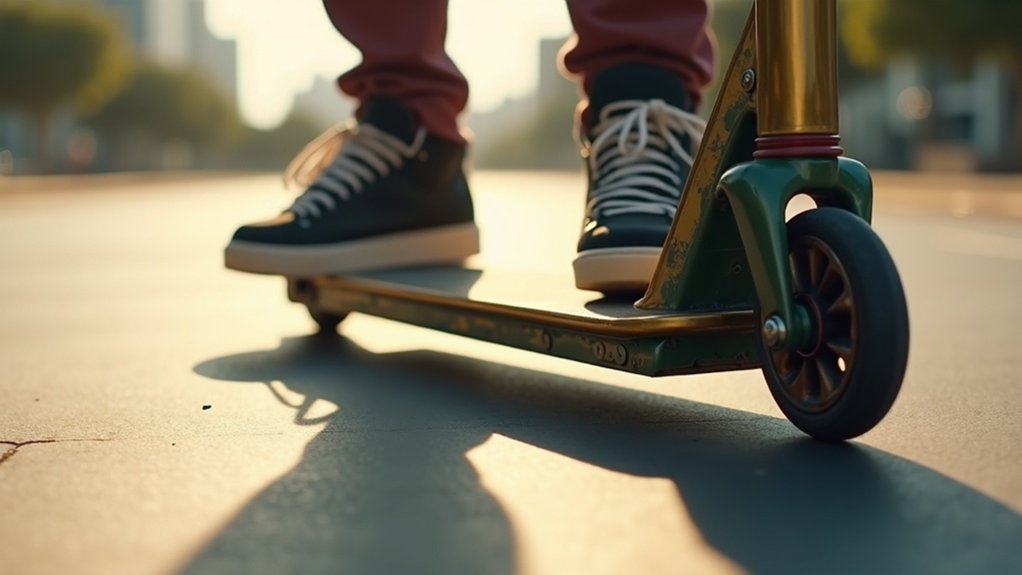
To achieve balance on a scooter deck, position your dominant foot near the center and place your non-dominant foot slightly behind it. Keep your feet parallel and shoulder-width apart to distribute weight evenly. Bend your ankles and keep your weight centered over the scooter for maximum control. Maintain an upright posture with relaxed shoulders and a steady grip on the handlebars. With practice, you’ll find your ideal stance and enhance your riding experience, uncovering more tips on mastering your skills.
Key Takeaways
- Position your dominant foot near the center of the scooter deck for optimal stability and control.
- Keep your feet parallel and shoulder-width apart to ensure even weight distribution.
- Place your non-dominant foot slightly behind the dominant foot to maintain balance.
- Bend your ankles and center your weight over the deck for better control.
- Maintain an upright posture with a straight back and relaxed shoulders for enhanced stability.
Understanding Your Master Leg for Balance
Your master leg plays an essential role in achieving balance on the scooter deck. Positioned near the center, it provides stability and control while riding.
Keeping your master leg firmly planted allows your action leg to alternate between pushing and gliding effectively. This distinction is vital for mastering riding techniques, as it enhances your overall balance.
To maintain ideal balance, make sure your action leg stays close to the deck, minimizing wobbling. By understanding the function of your master leg, you can improve your riding experience and gain confidence in your scooter skills, making each ride smoother and more enjoyable.
Proper Foot Placement on the Scooter Deck
To achieve ideal balance on your scooter, position your dominant foot near the center of the deck.
Keep your feet parallel and shoulder-width apart to guarantee even weight distribution.
This alignment not only enhances stability but also improves your control during turns and stops.
Dominant Foot Positioning
Properly positioning your dominant foot on the scooter deck is essential for maximizing stability and control while riding. Here are key points to take into account:
- Place your dominant foot near the center of the scooter for ideal stability.
- Position your non-dominant foot slightly behind to achieve a balanced stance.
- Keep both feet parallel to enhance weight distribution and reduce wobbling.
- Ascertain your ankles are bent and your weight is centered over the scooter to absorb vibrations.
- Experiment with foot placement until you find a stance that offers comfort and security, as preferences may vary.
Feet Parallel Alignment
Achieving feet parallel alignment on the scooter deck plays a significant role in enhancing your stability and control while riding.
Position your dominant foot near the center, with your other foot slightly behind, maintaining a stable stance. Confirm both feet are parallel, as this alignment boosts balance and prevents wobbling.
Keep your weight centered over the deck, distributing it evenly for maximum control. Aim for a stance akin to a surfer, with your feet shoulder-width apart, facilitating smooth navigation of turns.
Regular practice of this alignment builds muscle memory, fostering improved balance and confidence on your scooter.
Maintaining an Upright Posture for Stability
While riding a scooter, maintaining an upright posture is essential for stability and control.
To achieve this, focus on the following:
- Position your feet shoulder-width apart to optimize balance.
- Keep your dominant foot near the center of the deck.
- Maintain a straight back and relaxed shoulders for improved posture.
- Guarantee a firm yet relaxed grip on the handlebars.
- Keep your gaze on the horizon to enhance awareness.
Techniques for Steering and Turning
To effectively steer and turn your scooter, it’s important to position your dominant foot near the center of the deck, allowing for better control as you navigate.
Keep your other foot slightly behind to maintain a stable stance. Lean your body into the direction of the turn to enhance weight distribution and control.
Start with gentle, slow turns to build confidence in your steering. Avoid oversteering by making subtle adjustments with your handlebars, ensuring balance and preventing wobbling.
Maintaining a steady speed while turning contributes to improved stability, making handling your scooter easier and more enjoyable.
Navigating Uneven Surfaces Safely
Mastering steering and turning sets the foundation for traversing various terrains, including uneven surfaces that can pose challenges.
To navigate safely, keep these tips in mind:
- Position your feet shoulder-width apart on the scooter deck.
- Center your weight evenly, adjusting for inclines or declines.
- Lean your body slightly to maintain balance while riding.
- Bend your knees and adopt a relaxed posture to absorb shocks.
- Engage your core muscles for stability and control.
Always remember to slow down when approaching uneven terrain, as this enhances your maneuverability and guarantees a smoother, safer ride.
Building Confidence Through Practice
As you practice balance on your scooter, you’ll quickly notice how repetition builds your confidence and enhances your skills. Start by practicing in a safe, open area, wearing protective gear to ease anxiety. Focus on small achievable balance goals, like maintaining a comfortable and stable position. Consistent practice will help you manage your balance effectively. Gradually increase your speed and complexity of maneuvers, such as turning and braking, while maintaining a steady pace.
| Practice Goal | Duration | Complexity Level |
|---|---|---|
| Maintain balance for 10 sec | 5 minutes | Low |
| Perform gentle turns | 10 minutes | Medium |
| Brake smoothly | 10 minutes | Medium |
| Ride at increased speed | 15 minutes | High |