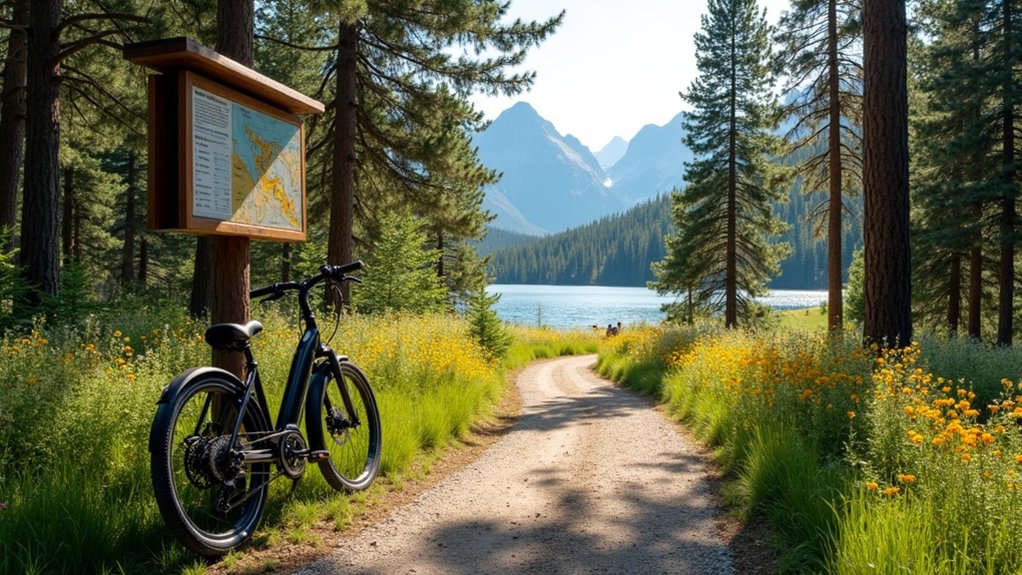
You can ride e-bikes on many national and state park paths, but the rules vary widely. In national parks, Class 1 and 2 e-bikes are typically allowed on paved roads and trails, while Class 3 might face restrictions. For state parks, some only permit Class 1 e-bikes, so it’s wise to check specific regulations. Always respect speed limits and other trail users. There’s so much more to contemplate about e-bike rules and etiquette in different areas!
Key Takeaways
- E-bikes are permitted on roads and paved trails in national parks where non-electric bicycles are allowed.
- Class 1 and Class 2 e-bikes generally have broader access on state park trails compared to Class 3 e-bikes.
- Always check specific park websites for detailed regulations regarding e-bike access and speed limits.
- U.S. Forest Service allows e-bikes only on designated motorized trails and forest roads, not on hiking paths.
- BLM permits e-bikes on non-motorized trails and OHV areas, depending on local regulations.
Understanding Electric Bicycle Classifications
When it comes to exploring national or state park paths, have you ever wondered how electric bicycles are classified? Understanding this classification can enhance your riding experience.
Exploring national or state park paths? Discover how electric bicycles are classified to enhance your riding experience.
Electric bikes fall into three categories:
- Class 1 e-bikes provide pedal-assist up to 20 mph,
- Class 2 e-bikes offer both pedal-assist and throttle, also up to 20 mph.
- Class 3 e-bikes, however, can assist you up to 28 mph.
Generally, Class 1 and Class 2 e-bikes are allowed on trails where traditional bicycles ride freely, but Class 3 might face more restrictions.
Knowing these distinctions helps guarantee your adventures stay enjoyable and compliant.
E-Bike Regulations in National Parks
Understanding the regulations surrounding e-bikes in national parks can greatly enhance your outdoor adventures.
The National Park Service allows e-bikes on roads and paved trails where non-electric bicycles are permitted, but rules vary by park. E-bikes are classified into three categories, with specific regulations on throttle use and speed limits for each class.
Most hiking-only trails prohibit e-bikes, ensuring non-motorized users can enjoy these areas undisturbed.
Always check the official website of your chosen park for detailed information on e-bike access and any specific restrictions, so you can ride responsibly and enjoy the beauty of nature.
E-Bike Access in U.S. National Forests
As you venture into U.S. National Forests, be aware that e-bikes are classified as motorized vehicles by the U.S. Forest Service.
This means you can only ride them on designated motorized trails and forest roads. Most hiking and non-motorized biking paths are off-limits, so checking the local Motor Vehicle Use Map (MVUM) is vital for finding e-bike-friendly trails.
Compliance with local regulations is essential to avoid penalties. For those exploring rugged terrain, consider the Dirt Goat 96V, perfect for backcountry adventures.
Always consult the USFS website or local ranger districts for the latest e-bike access information.
Riding E-Bikes on Bureau of Land Management Land
Exploring the vast landscapes of Bureau of Land Management (BLM) land offers a thrilling opportunity for e-bike enthusiasts.
The BLM allows Class 1, 2, and 3 e-bikes on non-motorized trails, depending on local field office regulations. You can ride your e-bike in many open Off-Highway Vehicle (OHV) areas, where rugged terrain awaits you.
Always check the BLM Recreation Map for specific trail access and e-bike permissions. Remember, your e-bike must comply with local regulations, including speed limits and trail etiquette.
For an unforgettable ride, consider the Billy Goat V3, perfect for traversing diverse public lands.
State Park E-Bike Policies and Trail Etiquette
While many state parks welcome e-bikes on designated trails, the specific regulations can vary considerably from one park to another, making it vital for riders to familiarize themselves with the local guidelines before hitting the trails.
Some parks allow all classes of e-bikes, while others restrict access to Class 1 only.
Practicing good trail etiquette is important—yield to hikers and equestrians, respect speed limits, and stick to designated paths.
By being aware of these regulations and following proper etiquette, you’ll help guarantee a safe and enjoyable experience for all trail users in state parks.
Happy riding!