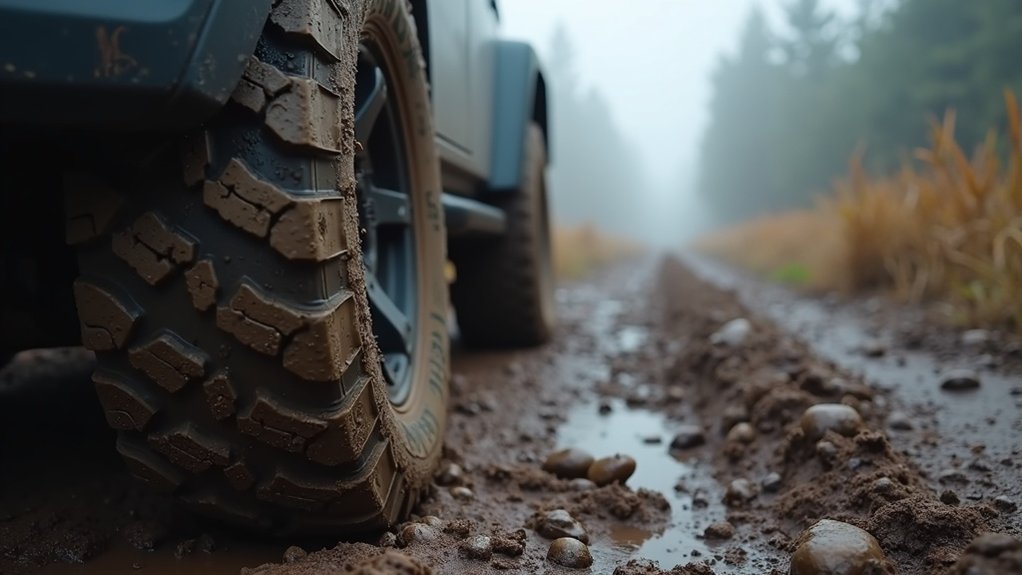
You should reduce tire pressure when tackling loose surfaces like sand, mud, or gravel to enhance traction. Lowering pressure increases the tire’s contact patch, improving grip and flotation. For sandy conditions, aim for 12-15 psi; rocky terrains benefit from 15-20 psi. However, be cautious of over-deflation as it can lead to handling issues and increased wear. Proper techniques and tools for airing down can maximize your off-road performance. Learn more about these methods and best practices.
Key Takeaways
- Reduce tire pressure when driving on sandy or loose gravel surfaces to improve flotation and traction, ideally to 12-15 psi.
- Lower tire pressure in rocky conditions to 15-20 psi for enhanced grip and to reduce the risk of punctures.
- In muddy situations, aim for 15-20 psi to improve tire conformity and traction on slippery surfaces.
- For deep snow, start at 26-28 psi and lower to 8-10 psi for maximum traction and to prevent sinking.
- Always monitor tire pressure regularly and adjust based on terrain conditions to maintain optimal vehicle handling and safety.
Understanding Tire Pressure for Off-Roading
When you’re off-roading, understanding tire pressure is vital for maximizing traction and performance.
Lower tire pressure increases the tire’s contact patch with the ground, improving grip on loose surfaces like sand, mud, and gravel. For ideal off-road performance, aim for a recommended tire pressure of 12-15 psi on sand and 15-20 psi on rocky terrains.
Lowering tire pressure enhances grip on loose surfaces, with 12-15 psi optimal for sand and 15-20 psi for rocky terrains.
This adjustment not only enhances traction but also reduces the risk of punctures by allowing tires to better conform to sharp objects.
Additionally, monitoring tire pressure during your adventure is imperative, as improper inflation can negatively affect vehicle handling and increase blowout risks.
The Concept of Airing Down
Airing down is a tactical maneuver that off-road enthusiasts employ to enhance traction on challenging terrains. By reducing tire pressure, you increase the tire’s footprint, allowing it to conform better to obstacles and absorb shocks, which ultimately improves grip.
| Terrain Type | Recommended Tire Pressure (psi) | Benefits |
|---|---|---|
| Sand | 12-15 | Increased surface contact |
| Rocky | 15-20 | Better obstacle conformity |
| Mud | 15-20 | Enhanced grip and comfort |
Remember to reinflate tires to manufacturer-recommended pressures after off-roading to maintain safe handling and prevent excessive wear on paved roads.
Benefits of Airing Down for Off-Road Performance
Reducing tire pressure greatly enhances off-road performance by improving traction and stability across various terrains.
Lower air in your tires can markedly boost your vehicle’s off-road prowess. Here are key benefits:
Reducing tire pressure significantly enhances off-road capabilities, offering improved traction and stability across challenging terrains.
- Increased Surface Area: Enhances traction on loose surfaces by up to 80% in length and 20% in width.
- Improved Flotation: Lowering to 12-15 psi in sand prevents sinking.
- Obstacle Conformity: Softer tires grip better, reducing puncture risk on uneven terrain.
- Enhanced Ride Comfort: Absorbs shocks, providing a smoother experience over bumpy trails.
Adjusting tire pressure based on conditions is vital for ideal off-road control.
Identifying the Right Conditions for Airing Down
Understanding the right conditions for lowering tire pressure is essential for maximizing off-road traction and performance.
In sandy terrains, reducing tire pressure to 12-15 psi enhances flotation and grip, preventing sinking.
For muddy conditions, lowering pressure to 15-20 psi allows your tires to conform, improving control on slippery surfaces.
Similarly, rocky terrains benefit from a range of 15-20 psi, balancing traction and puncture risk.
Always evaluate the specific terrain and adjust tire pressure accordingly, considering factors like tire construction, vehicle weight, and driving speed.
This tailored approach guarantees you optimize traction and maintain vehicle performance across varied off-road conditions.
Guideline for Ideal Tire Pressure for Different Off-Road Conditions
Understanding the ideal tire pressure for various off-road conditions is essential for maximizing traction.
For instance, you’ll want to adjust your tire pressure based on whether you’re driving through sand, rocky terrain, or deep snow.
Each terrain presents unique challenges, requiring specific pressure guidelines to optimize performance and maintain control.
Terrain-Specific Pressure Recommendations
When maneuvering various off-road terrains, adjusting your tire pressure is essential for maximizing traction and performance.
Here are terrain-specific pressure recommendations for ideal tire pressure:
- Sandy/Loose Gravel: 12-15 psi for better flotation and to prevent sinking.
- Rocky Conditions: 15-20 psi to enhance traction and minimize puncture risks.
- Muddy Situations: Maintain 15-20 psi to allow tires to conform and grip obstacles.
- Deep Snow: Start at 26-28 psi, but consider airing down to 8-10 psi for maximum traction when needed.
Always assess vehicle weight and tire construction when determining ideal tire pressure.
Adjusting Pressure for Conditions
Adjusting tire pressure based on specific off-road conditions is essential for optimizing traction and vehicle control.
For sandy or loose gravel, reduce tire pressure to 12-15 psi to enhance flotation.
In rocky terrains, a range of 15-20 psi is recommended for improved grip and reduced puncture risks.
When maneuvering through muddy environments, adjust to 15-20 psi based on mud depth and stickiness to prevent sinking.
In deep snow, standard pressure is 26-28 psi, but airing down to 8-10 psi greatly boosts traction.
Always consider your vehicle type, tire size, and load to determine the ideal tire pressure for effective off-roading.
Risks of Over Deflation
Over-deflation poses significant risks that can undermine your vehicle’s performance and safety.
You may experience handling issues on paved surfaces, making it challenging to maintain control during turns or sudden maneuvers.
Additionally, excessive tire flex can lead to rapid wear and increase the likelihood of blowouts, highlighting the importance of adhering to manufacturer pressure recommendations.
Handling Issues on Pavement
While enjoying off-road adventures, you might find yourself tempted to lower tire pressure for better traction. However, you should be cautious of handling issues when reverting back to pavement. Under-inflated tires can compromise your vehicle’s control and safety.
Here are four key points to take into account:
- Over-deflation may cause tire bead unseating during cornering.
- Softer tires generate excessive heat, risking tire damage.
- Poor steering response can occur with under-inflated tires.
- Always reinflate tires to recommended pressure for ideal performance.
Regularly checking tire pressure is essential to maintain handling and prevent dangerous blowouts on paved roads.
Increased Tire Damage Risk
When you lower tire pressure to enhance traction on rough terrain, you greatly increase the risk of tire damage.
Operating at lower psi can lead to excessive sidewall flex, making your tires vulnerable to punctures and blowouts.
Additionally, if you shift back to paved surfaces, the instability of under-inflated tires can compromise steering and braking performance, escalating safety concerns.
The potential for tires to unseat from rims during sharp turns or high speeds further intensifies the risk.
Finally, driving on under-inflated tires accelerates wear and tear, notably shortening their lifespan and requiring costly premature replacements.
Proper pressure management is essential.
Potential Blowout Hazards
Reducing tire pressure can enhance traction, but it also introduces significant blowout hazards. If you’re not careful, you might face:
- Rim Unseating: Excessively low tire pressure can cause tires to unseat during sharp turns or high-speed driving.
- Sidewall Damage: Increased flexing from under-inflation may compromise structural integrity, leading to failure.
- Overheating: Extra flex generates heat, raising the risk of a tire blowout.
- Unpredictable Handling: Over-deflated tires reduce vehicle control, increasing accident likelihood.
To stay safe, always monitor tire pressure and avoid dropping it too low, especially without beadlock wheels.
Tools for Airing Down Tires
To achieve ideal traction during off-roading, having the right tools for airing down tires is fundamental. Tire deflators allow you to quickly lower tire pressure uniformly across all tires, maximizing performance.
Quick-release deflators enhance efficiency, enabling rapid deflation without manual adjustments. Once your adventure concludes, portable tire inflators are essential for reinflating your tires, with options ranging from manual to electric models.
To guarantee accuracy, tire gauges are critical for measuring tire pressure before and after adjustments, ensuring optimal levels for the terrain. Maintaining correct tire pressure enhances safety and performance during both off-roading and regular driving.
Step-by-step Guide to Airing Down Tires for Off-Roading
Airing down your tires is an essential step for optimizing off-road traction and performance. Follow this step-by-step guide:
Airing down your tires enhances off-road traction and performance—follow the essential steps for optimal results.
- Check the initial tire pressure with a reliable gauge for accurate readings.
- Attach a tire deflator to the valve stem and gently open the valve, monitoring the pressure as it decreases.
- Aim for specific PSI targets: 12-15 psi for sand and 15-20 psi for rocky terrain.
- Repeat for all tires to maintain uniformity in pressure.
Once your off-roading adventure is complete, remember to inflate tires back to the manufacturer’s recommended pressure for safe handling and to prevent premature tire wear.