To set your cleat position with clip-in pedals, start by loosening the cleats and aligning them under the ball of your foot for ideal power transfer. Make sure your foot points forward when clipped in, adjusting the rotation as needed. After tightening, conduct a test ride to evaluate comfort and efficiency. Remember to regularly check and maintain cleat tightness. You’ll find additional tips to enhance your setup and riding experience as you continue to explore.
Key Takeaways
- Loosen cleats with a 4mm Allen wrench and align the center of the cleat under the ball of your foot.
- Ensure your foot points forward when clipped in; adjust cleat rotation accordingly to prevent knee strain.
- Use a mirror or video to check knee alignment while pedaling to confirm proper cleat positioning.
- Conduct a test ride to evaluate comfort and make any necessary adjustments for optimal power transfer.
- Regularly inspect and tighten cleats to maintain proper positioning and replace them every 3,000-5,000 miles.
Importance of Correct Cleat Adjustment
When it comes to cycling, the position of your cleats can make or break your ride. Proper cleat adjustment is essential for efficient power transfer, ensuring the pedal’s center aligns with the ball of your foot.
When you have properly positioned cleats, you promote natural foot positioning, which helps prevent knee pain and reduces the risk of injuries. Misplaced cleats can lead to discomfort and instability, negatively affecting your performance.
Regularly adjusting your cleats not only enhances your comfort but also allows for a more pleasant and efficient ride as your fitness levels evolve.
Prioritize ideal cleat placement for the best experience.
Steps to Adjust Cleats Correctly
To achieve the perfect cleat position, start by loosening the cleats on your cycling shoes with a 4mm allen wrench, which allows you to experiment with their placement.
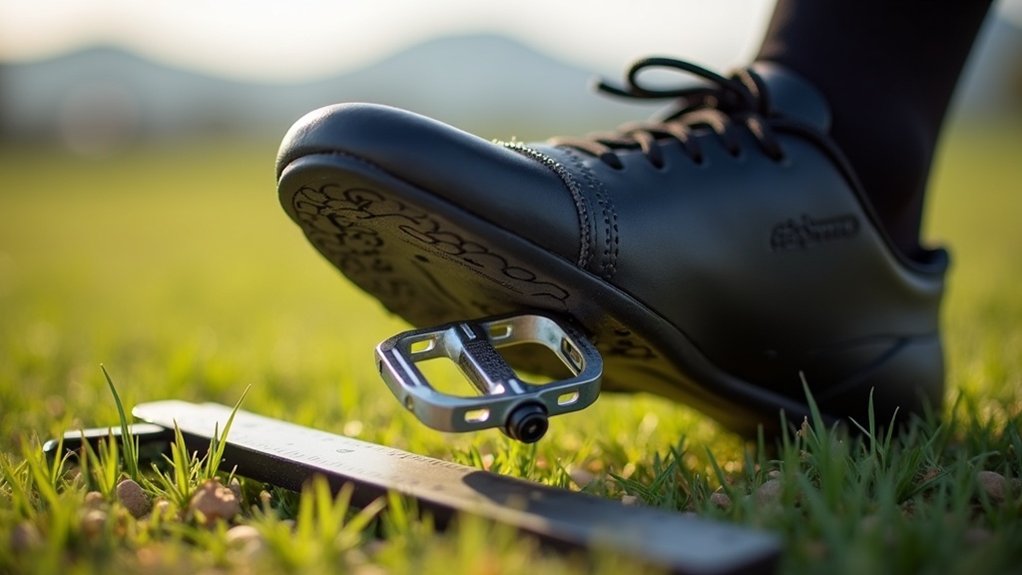
Align the center of the cleat with the ball of your foot, marking it for precision before tightening. Confirm that when clipped in, your foot points forward; adjust the cleat rotation to keep your knees aligned.
Align your cleat with the ball of your foot for optimal positioning, ensuring your knees stay aligned while riding.
Conduct a test ride to evaluate comfort and efficient riding. Afterward, make any necessary adjustments.
Regularly check the tightness of your cleats and consider a professional bike fit yearly for ideal performance.
Fine Adjustment Process
As you refine your cleat position, it’s crucial to guarantee your foot maintains a neutral alignment while clipped in, avoiding any excessive inward or outward rotation.
Follow these steps for fine adjustments:
- Rotate your heels inward and outward to assess clearance and float.
- Use a mirror or record your pedaling to confirm proper knee alignment.
- Conduct a short test ride to evaluate comfort and power transfer, tuning the foot position as needed.
Make sure your adjusted cleats are securely tightened with an Allen key to prevent any shifting.
Fine adjustments can greatly enhance your overall riding experience!
Important Tips for Cleat Adjustment
After fine-tuning your cleat position, it’s time to focus on some important tips for achieving the best fit.
Position your cleats under the ball of your foot, aligning them with the pedal axle for better power transfer. Use a mirror or video to verify that your knees remain straight over your feet while pedaling.
Adjust cleats laterally to find your ideal stance width, and tighten them securely with a 4mm Allen wrench.
After adjustments, conduct a test ride to gauge comfort and efficiency; be ready to tweak your setup if you experience pain while riding.
Regular Maintenance and Check-ups
While you may feel confident in your cleat setup, regular maintenance and check-ups are essential to confirm peak performance and comfort.
Regular maintenance of your cleat setup is crucial for ensuring optimal performance and comfort during rides.
Here are three key practices to follow:
- Inspect Cleats: Check for wear, replacing them every 3,000-5,000 miles to maintain efficiency.
- Annual Bike Fittings: Reassess cleat placement to confirm proper alignment for comfort and efficiency.
- Tightness Checks: Periodically tighten cleat bolts to 5-6NM to prevent loosening.