
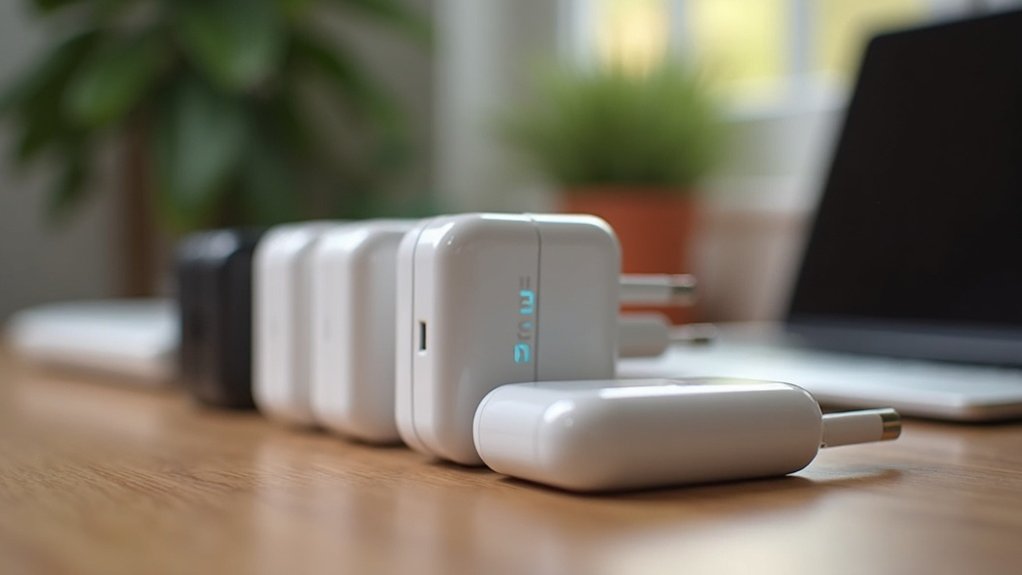
To select chargers with auto shutoff, look for built-in voltage detection systems to prevent overcharging and prolong battery life. Make sure the charger has a timer function and automatic trickle charging for ideal maintenance. Familiarize yourself with charging stages—bulk, absorption, and float mode—because this knowledge aids in finding effective chargers. Finally, check compatibility with your battery type to avoid safety hazards. Keep finding tips and product recommendations to enhance your charging experience.
Key Takeaways
- Look for chargers with built-in voltage detection systems to prevent overcharging and enhance battery safety.
- Ensure compatibility with your specific battery chemistry for tailored charging methods and optimal performance.
- Select chargers that feature a timer function for greater control over charging durations and processes.
- Choose models that offer automatic trickle charging to maintain battery levels without risking overcharging.
- Consider brands known for their advanced technology and effective auto shutoff features, such as NOCO or Battery Tender.
Importance of Auto Shutoff in Battery Chargers
When you use a battery charger, understanding the importance of auto shutoff can greatly enhance both safety and efficiency.
The auto shutoff feature prevents overcharging, which can considerably reduce battery lifespan and lead to safety hazards. Modern chargers achieve this through voltage detection mechanisms that disconnect power once the battery is fully charged.
This functionality not only safeguards the battery but also simplifies the design with comparator circuits, allowing for effective monitoring without complex programming.
Enhanced safety measures are crucial, particularly for sensitive chemistries like lithium, which require precise charging methods to avoid damage and guarantee peak performance.
Features to Look for in Auto Shutoff Chargers
Choosing the right auto shutoff charger involves several key features that enhance performance and safety.
Look for chargers with built-in voltage detection systems that automatically halt charging at ideal voltage to prevent overcharging. A timer function can give you added control over charging durations.
Seek chargers featuring built-in voltage detection to stop charging at optimal levels and include a timer for enhanced control.
Additionally, consider models that offer automatic trickle charging, which maintains battery levels without overcharging as it nears full capacity.
Visual indicators or alarms are essential for signaling completion or issues during charging, guaranteeing user safety.
Finally, verify compatibility with your specific battery chemistry, as different battery charger types require tailored charging methods for effective auto shutoff functionality.
Understanding Charging Stages
Understanding the charging stages is essential for maximizing the efficiency and lifespan of your batteries. Charging typically involves three main stages: bulk, absorption, and float mode.
In the bulk stage, the charger delivers maximum current until the battery reaches a specific voltage threshold. Next, during absorption, the charger maintains a constant voltage while the current gradually decreases, ensuring the battery achieves full capacity without overcharging.
Finally, in float mode, a lower voltage keeps the battery topped off, preventing gassing and damage. Recognizing these stages helps you select chargers with auto shutoff features that effectively monitor and protect your battery life.
Compatibility With Battery Types
When you select a charger with auto shutoff, it’s essential to guarantee compatibility with your battery’s chemistry.
Different types, like lead-acid and lithium-ion, have specific voltage requirements that the charger must match to function safely and effectively.
Always check the charger’s specifications to avoid potential damage and ensure peak charging performance.
Battery Chemistry Compatibility
Battery chemistry compatibility is essential for maximizing performance and safety, as different types—like lead-acid, lithium-ion, and AGM—require distinct charging methods.
Here are key considerations:
- Lithium-ion needs precise voltage detection to avoid overcharging.
- Lead-acid typically uses constant voltage charging.
- Smart chargers adapt their process based on battery chemistry.
- Adjustable settings enhance compatibility for multiple battery types.
- Mismatched chargers can lead to safety hazards and shorten battery life.
Always verify battery chemistry compatibility before purchasing a charger.
This guarantees you choose the right smart chargers that match the required charger voltage for peak charging efficiency.
Voltage Matching Requirements
Selecting a charger that matches the voltage of your battery is essential for safe and effective charging. Using the wrong voltage can cause overheating, reduced battery life, or even failure. Different battery types, like lead-acid or lithium, require specific chargers tailored to their unique voltage profiles. For instance, lithium batteries need chargers with a special setting to prevent overcharging. Always verify compatibility before use to optimize charging performance.
| Battery Type | Recommended Voltage |
|---|---|
| Lead-Acid | 12V |
| AGM | 12V |
| Lithium | 3.7V per cell |
| NiMH | 1.2V per cell |
User Reviews and Performance Insights
How do users perceive the effectiveness of chargers with auto shutoff features? Many appreciate these chargers for enhancing battery longevity and safety.
Here are some key insights:
- Automatic shutoff prevents overcharging, extending battery life.
- Built-in voltage detection improves reliability by monitoring battery status.
- Smart chargers with temperature compensation optimize charging efficiency.
- Visual indicators or alarms notify you when charging is complete.
- Users enjoy reduced need for manual monitoring during charging cycles.
Recommended Brands and Models
When it comes to choosing chargers with auto shutoff features, several brands stand out for their performance and reliability.
NOCO’s Genius series offers models that automatically detect battery types, optimizing charging without user intervention.
NOCO’s Genius series features models that intelligently identify battery types for optimized, hassle-free charging.
Battery Tender’s Smart Battery Maintainers utilize a four-step process with auto shutoff, ideal for maintaining battery health during inactivity.
CTEK chargers employ advanced technology, providing auto shutoff and reconditioning functions to restore battery capacity safely.
Anker’s PowerCore series integrates smart charging technology that stops charging once the battery is full, promoting safe usage.
These options guarantee your charger enhances battery longevity and safety effectively.
Maintenance Tips for Long-Term Battery Health
To guarantee long-term battery health, establish a regular charging schedule to keep your battery voltage within the ideal range.
When storing batteries for extended periods, make certain to do so under proper conditions to minimize self-discharge and maintain charge levels.
Regular Charging Schedule
A consistent charging schedule is essential for maintaining your battery’s health and performance over time.
Here are some key tips to follow:
- Fully charge batteries before extended inactivity.
- Use chargers with automatic shutoff to prevent overcharging.
- Monitor voltage levels; keep them between 2.25V-2.30V per cell.
- Regularly check and maintain water levels in flooded batteries.
- Implement a routine for periodic voltage checks and inspections.
Proper Storage Conditions
Proper storage conditions are essential for preserving your battery’s longevity and performance. Store batteries in a cool, dry environment, ideally between 32°F and 77°F (0°C to 25°C), to prevent damage.
Always disconnect the charger during extended storage to avoid parasitic drain. For lead-acid batteries, periodically check and top off the electrolyte levels, making sure they remain above the plates to prevent sulfation.
Utilize a smart charger with auto shut-off features to maintain ideal charge voltage without overcharging. Regularly monitor battery voltage, aiming to keep it above the recommended float voltage to guarantee readiness for immediate use.