
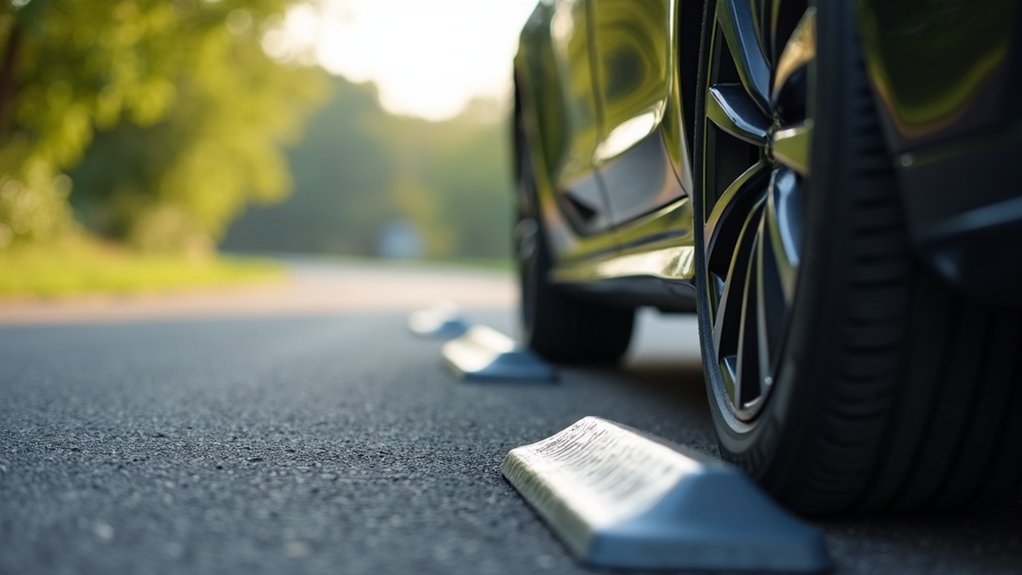
To roll through speed humps safely, spot them early and approach at a steady speed of 5-10 mph. Gradually ease off the accelerator and brake gently before crossing. Keep your wheels straight and aim for the center of the bump. For low clearance vehicles, approach at a slight angle to minimize impact and lower your speed further. After crossing, check for unusual noises or vibrations, as these could indicate issues. More insights on maneuvering speed bumps effectively await you.
Key Takeaways
- Spot speed bumps early using warning signs and road markings to prepare for safe navigation.
- Gradually reduce speed to 5-10 mph before reaching the bump for a smoother crossing.
- Approach speed bumps straight and aim for the center to minimize impact and maintain stability.
- For low clearance vehicles, approach at a slight angle and reduce speed below the typical range for safety.
- After crossing, check for unusual noises, fluid leaks, and steering responsiveness to ensure vehicle integrity.
Why Do We Have Speed Bumps?
Speed bumps play an essential role in enhancing road safety, especially in areas with high foot traffic. Their primary purpose is to reduce vehicle speed, particularly in residential neighborhoods and near schools.
By slowing down vehicles to between 2-10 MPH, speed bumps considerably improve pedestrian safety, minimizing the risk of accidents involving vulnerable road users.
Speed bumps significantly enhance pedestrian safety by reducing vehicle speeds to 2-10 MPH, lowering accident risks for vulnerable road users.
Introduced in New Jersey in 1906 and popularized in the UK during the 1980s, these structures also help reduce noise pollution from fast-moving cars.
Ultimately, speed bumps foster cautious driving behavior, creating safer environments for everyone who shares the road.
How to Approach Speed Bumps Safely
Approaching speed bumps requires careful attention to guarantee a smooth and safe crossing. Spot speed bumps early by observing warning signs and road markings.
Gradually lower your speed by easing off the accelerator and braking gently before reaching the bump. Keeping your wheels straight is essential; drive over the center of the speed bump with your wheels facing forward for ideal comfort.
Aim for a steady speed of 5-10 mph, adjusting as needed for larger bumps. Be cautious of bigger obstacles, slowing down further to prevent excessive compression on your front suspension and avoid potential vehicle damage.
Tips for Low Clearance or Heavy Vehicles
When maneuvering speed humps, it’s essential to take into account the specific needs of low clearance or heavy vehicles to avoid potential damage.
Approach bumps at a slight angle, ensuring safety, to minimize impact on your suspension and prevent undercarriage scraping. Reduce your speed below the typical 5-10 mph; this slower pace helps prevent suspension compression.
Avoid harsh acceleration after crossing a speed hump, as it can cause the rear suspension to dip. Regularly monitor your vehicle’s height for scraping signs and schedule routine suspension inspections to maintain performance, especially for low clearance models.
The Dangers of Hitting Speed Bumps Badly
Neglecting to navigate speed bumps properly can lead to serious repercussions for your vehicle. Hitting speed humps at excessive speeds can severely damage your suspension, resulting in worn or broken components that demand costly repairs.
Low clearance vehicles are particularly vulnerable; the front end may scrape or bottom out, risking undercarriage damage. In addition, harsh impacts can cause uneven tire wear, leading to sidewall bulges and potential punctures.
You might also experience poor handling and instability, increasing the risk of accidents. Consistent hard impacts can create rattles and squeaks in your vehicle, signaling underlying mechanical issues needing immediate attention.
Should You Check Your Car After Hitting a Speed Bump?
How can you guarantee your vehicle remains in good condition after traversing a speed bump?
It’s vital to check your car immediately afterward. Listen for unusual noises like knocking or squeaking, which may indicate suspension damage.
Inspect underneath for any leaking fluids, signaling potential issues. Pay attention to how your steering responds; if it pulls to one side, alignment problems could arise from the impact.
Also, feel for vibrations in the steering wheel or seat, as these may suggest tire damage.
Regular maintenance checks are essential to verify your vehicle’s safety and peak performance after hitting a bump.