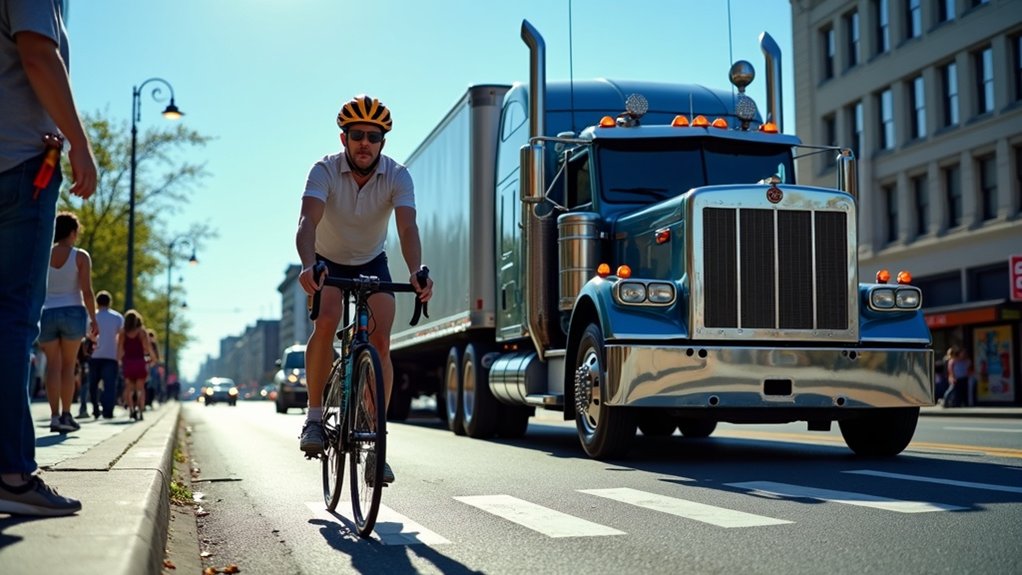
To ride safely around large trucks, be aware of their blind spots, known as No-Zones, primarily on the right side and behind. Always signal and check mirrors before passing, keeping at least three car lengths behind. Maintain a four-second following distance to allow for the truck’s longer stopping distance. Avoid tailgating and anticipate wide turns, as trucks often swing left before turning right. For more helpful tips on managing truck interactions, keep exploring.
Key Takeaways
- Always stay out of the truck’s blind spots, especially on the right side and behind the vehicle.
- Maintain a safe following distance of at least four seconds to allow for longer stopping times.
- Use turn signals and check mirrors before passing, ensuring the truck’s trailer is fully visible before merging back.
- Avoid tailgating large trucks, as they require significantly more distance to stop compared to passenger vehicles.
- Watch for wide turns, and keep a safe distance from the truck’s front and its trailer while it maneuvers.
Understanding the No-Zone Around Trucks
The No-Zone around large trucks presents a critical safety concern for all drivers.
These blind spots, particularly on the right side and behind the truck, can obscure your presence from truck drivers. If you can’t see their mirrors, they likely can’t see you, placing you in the No-Zone.
Blind spots on large trucks can hide your presence; if you can’t see their mirrors, they probably can’t see you.
There’s no standardized radius for these blind spots, underscoring the importance of remaining aware when near trucks.
As a passenger vehicle operator, understanding the No-Zone helps you navigate safely around large trucks, especially when passing.
Always remember that trucks require more space and time to react than your vehicle does.
Best Practices for Passing Trucks Safely
When maneuvering the roadways, knowing how to pass large trucks safely is essential for your safety and that of others.
To drive safely around trucks, follow these best practices:
- Always use your turn signals and check your mirrors.
- Maintain a safe distance of at least three car lengths behind the truck before you pass.
- Pass large trucks on the left side to minimize time in their blind spots.
- Wait until the truck’s trailer is fully visible in your rearview mirror before merging back.
Merging Considerations When Approaching Trucks
Merging in front of large trucks requires careful consideration due to their extended stopping distances and substantial weight.
Always verify you can see the entire front of the truck in your rearview mirror before moving back into its lane. Maintain a safe following distance of at least four seconds behind a semi-truck, allowing both vehicles to react if necessary.
Signal your merging intentions well in advance, making it easier for the truck driver to adjust speed. Avoid merging immediately after passing; wait until you can see the trailer.
The Dangers of Tailgating Large Trucks
Tailgating large trucks poses significant dangers that every driver should recognize. When you follow too closely, you greatly reduce visibility for both yourself and the truck driver, complicating reaction times.
Tailgating large trucks significantly increases danger, reducing visibility and complicating reaction times for all drivers involved.
- Trucks need almost two football fields to stop at 65 mph.
- Tailgating raises the risk of rear-end collisions.
- Aggressive maneuvers, like cutting off a truck, can provoke dangerous situations.
- Maintain a following distance of at least four seconds to guarantee safe driving.
Understanding these factors is essential for avoiding accidents and guaranteeing safety on the road. Stay back, keep your distance, and drive responsibly around large trucks.
Navigating Wide Turns Safely Around Trucks
Maneuvering around large trucks requires vigilance, especially during wide turns, as these vehicles need ample space to maneuver safely. Always maintain a safe distance from the front of the truck’s trailer and watch for turn signals. Avoid stopping at the white line in double-turning lanes next to a truck, as it can hinder its movement. Be mindful that trucks often swing wide to the left before making a right turn; position yourself accordingly. Anticipate movements and stay clear of the truck’s path for your safety.
| Action | Reason | Safety Tip |
|---|---|---|
| Maintain distance | Trucks need space for turns | Stay behind the trailer |
| Watch signals | Indicate upcoming turns | Prepare to yield |
| Avoid the white line | Prevents obstruction of turns | Stay back |
| Anticipate swings | Trucks may turn wider than expected | Keep a safe distance |
Tips for Staying Alert and Focused While Driving
While driving near large trucks, staying alert and focused is essential to ensuring your safety and that of others on the road.
To minimize the risk of personal injury, consider these tips:
- Stay off your phone and avoid texting—distractions can lead to accidents.
- Keep both hands on the wheel to maintain control, especially near large trucks.
- Regularly check mirrors and blind spots to see the trucks.
- Always pass with enough space, ensuring you can safely maneuver around large vehicles.