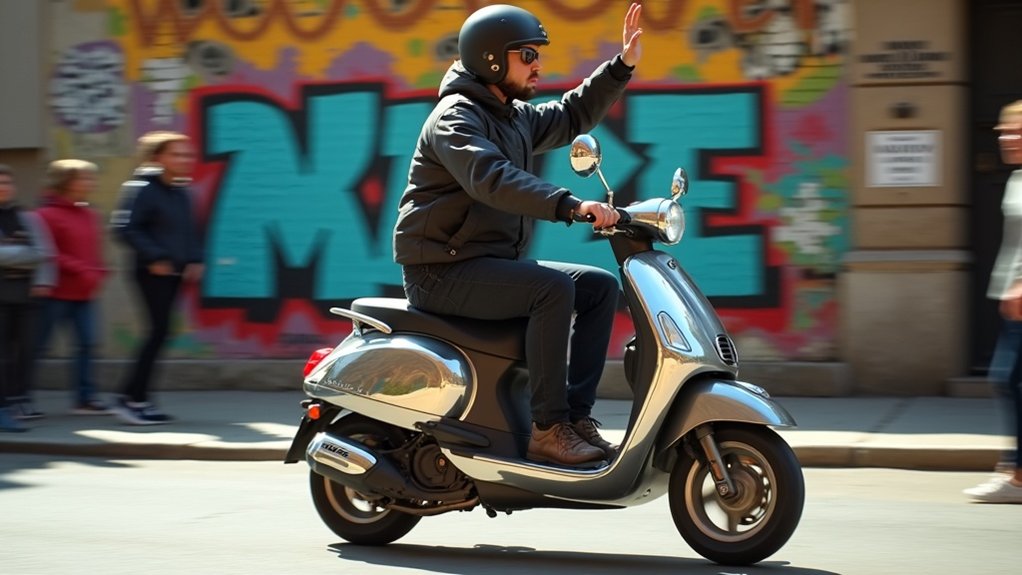
To practice one-handed signaling on scooters, start in a safe, open area like an empty parking lot. Master basic hand signals, extending your left arm for left turns and bending it down for stops. Build muscle memory by practicing stationary signals before trying them while riding. Gradually increase your speed in low-traffic settings, checking your surroundings to guarantee visibility. As you gain confidence, you’ll enhance your control and ability to communicate effectively with others on the road.
Key Takeaways
- Start practicing one-handed signaling in a flat, spacious area like an empty parking lot to ensure safety and focus.
- Begin with stationary practice to build muscle memory for left and right turn signals before introducing movement.
- Use your left hand for left turns and your right hand for right turns to maintain clarity in communication.
- Gradually increase your speed while practicing to gain comfort with one-handed signaling in low-traffic environments.
- Regularly check your surroundings while signaling to ensure visibility and improve accuracy in your hand signals.
Understanding the Importance of Signaling
When you ride an electric scooter, signaling isn’t just a good practice; it’s fundamental for your safety and that of others on the road. Proper signaling communicates your intentions clearly, helping everyone understand your movements.
Remember, electric scooters follow the same traffic laws as bicycles, making effective signaling critical for compliance and safety. Use hand signals like extending your arm horizontally for a left turn or bending it down to indicate a stop.
Practicing these signals while riding one-handed enhances your control, builds confidence, and prepares you for real-world traffic situations where predictability is essential for everyone’s safety.
Choosing a Safe Practice Area
Where can you find the best place to practice one-handed signaling on your scooter? Look for a flat, spacious area like an empty parking lot or a cul-de-sac.
These safe practice areas minimize the risk of collisions with road users. Guarantee minimal traffic so you can focus on mastering hand signals without distractions.
Avoid locations with obstacles like potholes or curbs that can disrupt your balance while signaling your intentions. Daylight hours are ideal for visibility, and consider practicing in a designated bike lane or low-traffic street to simulate real riding conditions safely.
Mastering Basic Hand Signals
Mastering basic hand signals is essential for safe scooter riding, especially when you’re signaling with one hand.
Start by practicing consistent signals while stationary to guarantee you can maintain balance before hitting the road.
Once you’re comfortable, apply these techniques on your rides to enhance predictability for yourself and other road users.
Importance of Consistent Signaling
Consistent signaling is essential for your safety and the safety of others on the road, as it enhances predictability in your movements.
When riding electric scooters, using clear hand signals helps drivers and pedestrians anticipate your actions. Practicing these signals regularly builds muscle memory, allowing you to maintain balance while indicating your intentions.
For instance, extending your left arm for a left turn or bending it downward to signal a stop communicates effectively.
By practicing in safe, open areas, you guarantee your signals are visible, making navigation smoother and safer for everyone involved.
Stay consistent, stay safe!
Techniques for One-Handed Practice
Practicing one-handed signaling is key to mastering your electric scooter skills while ensuring safety on the road.
Start in a safe, open area to maintain balance while using your left arm for hand signals. Extend your left arm straight out for left turns and bend your elbow at a 90-degree angle, palm up, for right turns. For stopping, bend your elbow again and point your palm downward.
Build confidence by practicing these signals while stationary before trying them in motion. Always check your surroundings to stay safe and improve your signaling accuracy as you ride.
Gradually Introducing One-Handed Riding
To get comfortable with one-handed riding, start by practicing while stationary to focus on your signaling technique.
Once you feel confident, gradually increase your speed while consistently executing your hand signals.
This approach helps build your skills and guarantees you can signal effectively as you navigate on the road.
Start With Stationary Practice
While you might feel enthusiastic to ride one-handed right away, starting with stationary practice on your electric scooter can greatly boost your confidence and control.
Begin by practicing hand signals while stationary to maintain balance. Extend your left arm and execute the intended signal smoothly, building muscle memory. This helps you become comfortable with signaling without losing control.
Once you feel steady, use a flat, open area to practice balancing with one hand while signaling with the other. Focus on clear hand signals for turns and stops, ensuring visibility to other road users, setting the foundation for successful one-handed riding.
Gradual Speed Increase
Once you’ve mastered stationary practice, it’s time to gradually introduce one-handed riding at a slow pace. Start in a safe area, maintaining a steady speed. As you grow comfortable, increase your speed while using one hand for signals. Practice with your non-dominant hand to enhance adaptability. Focus on smooth movements when signaling to keep your posture stable during turns. Here’s a simple plan:
| Speed Level | Hand Used | Signal Practice |
|---|---|---|
| Slow | Dominant | Right turn signal |
| Moderate | Non-Dominant | Left turn signal |
| Fast | Dominant | Stop signal |
| Variable | Non-Dominant | Right turn signal |
| Steady | Both | Combine signals |
Consistent Signal Execution
As you gain confidence in one-handed riding, consistent signal execution becomes essential for your safety and that of others on the road.
Start by practicing hand signals while stationary to build muscle memory. Gradually introduce one-handed riding by signaling with your dominant hand while keeping the other on the handlebars for balance.
Make sure your hand signals are clear and visible, extending your arm fully to communicate your intentions to drivers.
Begin in a safe, open area with minimal traffic to focus on smooth execution. Regular practice reinforces your ability to signal effectively while maintaining control, enhancing safety for everyone.
Combining Signals With Speed Control
To successfully combine signaling with speed control, you need to practice in a safe, open area where you can focus on balance.
Start by keeping one hand on the handlebars while extending your arm straight to signal a turn or stop. This method helps you maintain speed control throughout the maneuver.
Begin at slower speeds, gradually increasing your pace as you grow comfortable with one-handed signaling. Reinforce muscle memory by consistently using specific signals, like extending your left arm for a left turn.
Don’t forget to practice emergency braking techniques while signaling, ensuring safe and effective communication of your intentions.
Practicing in Different Conditions
Practicing one-handed signaling effectively requires adapting to various riding conditions, guaranteeing you’re prepared for real-world scenarios.
Start your practice sessions in a controlled environment, like an empty parking lot, to minimize distractions. Gradually introduce different surfaces, such as smooth pavement or slight inclines, to build confidence.
Try signaling during low-traffic times to get comfortable without the pressure of busy streets. Incorporate practice sessions in various weather conditions, steering clear of rain or slippery surfaces.
Focus on maintaining balance and control while signaling, aiming for smooth changes to enhance your overall riding skills and guarantee safety.
Building Confidence and Consistency
Building confidence and consistency in one-handed signaling is essential for safe scooter riding. Start practicing while stationary to maintain balance and control.
Begin with basic left and right turn signals, extending your arm smoothly while keeping your other hand on the handlebars. Gradually increase your speed in safe, low-traffic areas, focusing on your comfort level with signaling.
Regularly practice signaling for stops by extending your arm downward with your palm facing back. Set specific practice sessions to reinforce muscle memory, ensuring you execute signals clearly and consistently during actual riding situations.
With time and practice, you’ll gain confidence in your signaling.