To mount secondary eBike lights for redundancy, prioritize lights powered by your bike’s battery for convenience. Position them on the seat post or rear rack, 12-24 inches above ground for ideal visibility. Guarantee secure wiring connections and consider using heat-shrink tubing for moisture protection. Regularly test all light functions and maintain clarity in placement to avoid “lump of light” effects. Keep reading to explore additional options and best practices for enhancing your eBike lighting system.
Key Takeaways
- Prioritize mounting lights on the seat post or rear rack to enhance visibility and ensure redundancy.
- Position lights 12-24 inches above ground for optimal sightlines and to avoid light clumping.
- Securely fasten helmet lights for a 360-degree view, preventing them from shifting during rides.
- Use soldering techniques for reliable connections and cover with heat-shrink tubing to protect against moisture.
- Regularly inspect and test all lights for functionality and ensure they are free from wear and secure.
Selecting the Right Secondary Light
When selecting the right secondary light for your eBike, how do you guarantee it meets your needs for safety and functionality?
Prioritize lights powered by your bike’s battery, eliminating the hassle of frequent recharging. Look for high-quality options like the Supernova TL3 Pro, which provides superior brightness and durability.
Confirm it features integrated safety functions, such as LED turn signals or braking alerts, to enhance visibility at night. Compatibility with your existing eBike system is essential, so check for proprietary connectors.
Finally, assess placement options to maximize visibility, confirming the front light isn’t clumped with other lights for peak illumination.
Optimal Mounting Locations for Visibility
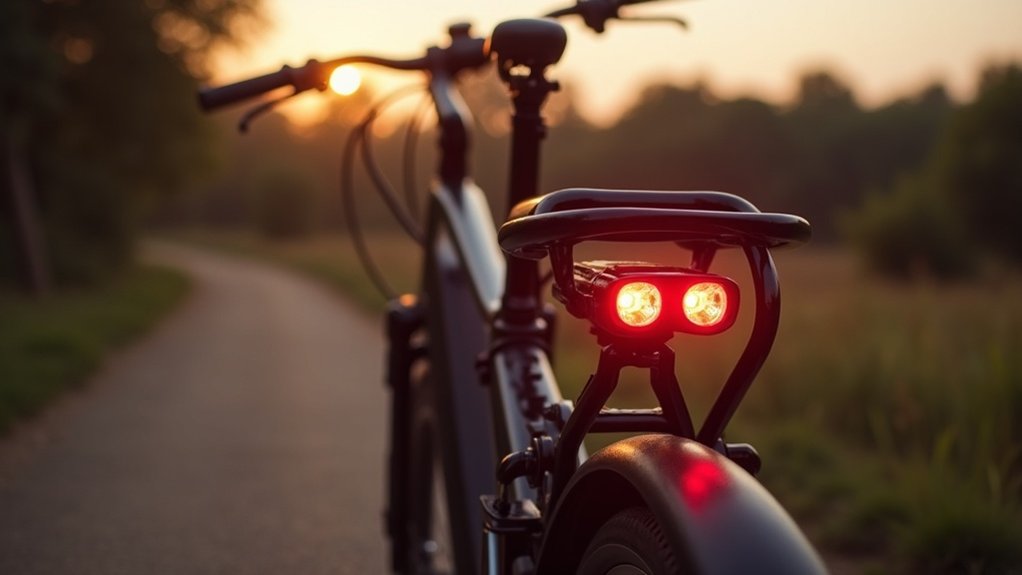
To maximize visibility and safety while riding your eBike, it’s crucial to mount secondary lights in ideal locations. Position lights on the seat post or rear rack to increase visibility, ensuring they’re at least 12-24 inches above ground for optimal sightlines over obstacles.
Adding helmet lights enhances visibility by providing a 360-degree view, especially in urban environments or during intersection navigation. Make sure these lights are securely fastened to prevent shifting, which could diminish their effectiveness.
Additionally, consider using reflective materials around the mounting area to further boost visibility in low-light conditions, improving overall safety on your rides.
Wiring Considerations for Redundancy
While adding secondary lights to your eBike can greatly enhance safety, it’s essential to confirm proper wiring for redundancy.
Start by identifying your existing voltage source to confirm compatibility with your bike’s electrical system. Use soldering techniques to connect the secondary lights to the wiring harness, paying close attention to the positive and negative connections.
To prevent overloading, calculate the total wattage of all connected lights, confirming it stays within the battery’s output capacity.
Finally, cover all wire connections with heat-shrink tubing for protection against moisture and abrasion, helping to extend the lifespan of your wiring setup.
Maintenance and Testing of Additional Lights
After guaranteeing proper wiring and redundancy for your secondary eBike lights, maintaining and testing these additions is essential for ideal performance.
Regularly inspect the connections and wiring to guarantee they’re secure and free from wear. Test your tail light and brake light functionality in various conditions, both daytime and nighttime, to assess visibility.
Frequently check the battery levels of battery-powered lights and keep spare batteries handy to prevent failures. Calibrate the braking functions for sensitivity to avoid false activations.
Finally, document all maintenance and performance to identify reliability patterns and address any issues promptly.
Exploring Alternative Light Options
As you explore alternative light options for your secondary eBike setup, consider the benefits of different types of lighting systems.
Battery-powered lights offer simpler installation, avoiding interference with existing wiring and ensuring waterproofing. When mounting, position the light higher or lower on the frame or even on your helmet for improved visibility.
Battery-powered lights simplify installation and enhance visibility, allowing for versatile mounting options while ensuring waterproofing.
Using lights with a brake function can enhance safety, though performance varies among models. Be mindful of placement to avoid the “lump of light” effect, ensuring your lights are better protected.
Regularly test all front lights under varying conditions to confirm reliability and performance through the two terminals.