
To measure crank length needs, you first need to know your leg length and riding style. Measure from the center of the bottom bracket axle to the pedal axle center for accuracy. Use the approximation of 20% of your leg length or 41% of your tibia length. This will help you determine the ideal crank length. Adjustments in crank length can impact your comfort and performance, so consider what follows to optimize your cycling experience.
Key Takeaways
- Measure from the center of the bottom bracket axle to the pedal axle center for accurate crank length.
- Use the Sprague Method to relate rider height to appropriate crank length.
- Ideal crank length is about 20% of leg length or 41% of tibia length.
- Evaluate existing crank length by checking stamped markings or measuring with a tape.
- Consider riding style, terrain, and comfort level when determining optimal crank length.
Understanding Crank Length and Its Importance
When you choose the right crank length, you’re not just picking a random measurement; you’re making a decision that can profoundly impact your cycling performance and comfort.
The ideal crank length typically corresponds to about 20% of your leg length or 41% of your tibia length, maximizing your power output. Shorter cranks enhance aerodynamics and may alleviate joint pain, while longer cranks provide increased torque for specific scenarios.
Your selection should consider personal factors like flexibility, riding style, and cycling goals, as incorrect lengths can lead to discomfort in the knees, hips, and back, ultimately affecting your overall cycling experience.
Measurement Methods for Crank Length
To determine the appropriate crank length, you’ll need to understand the established standards and measurement techniques.
Start by measuring from the bottom bracket axle to the pedal axle, ensuring accuracy through repeated checks.
Familiarize yourself with methods like the Sprague Method, which can help translate rider height into the ideal crank length.
Crank Length Standards
Understanding crank length standards is essential for maximizing your cycling performance, as accurate measurements directly influence comfort and efficiency.
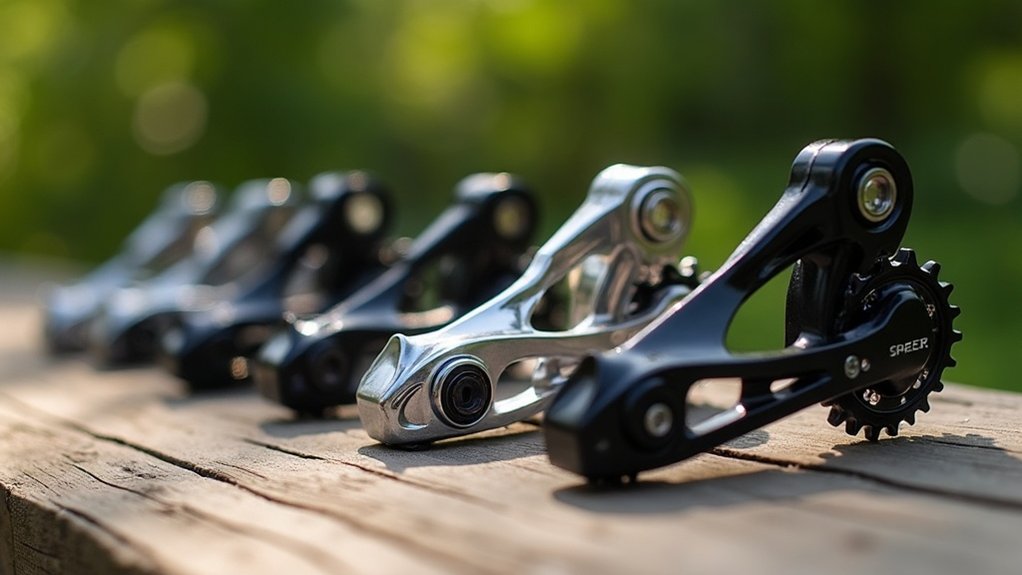
Crank arm length is measured from the bottom bracket axle center to the pedal axle center, with common crank lengths available at 170mm, 172.5mm, and 175mm.
Verify the crank length markings on the back side of the crank, near the pedal threads. Standard options typically range from 165mm to 180mm, in 2.5mm increments.
To find your ideal crank length, consider using formulas like 20% of your leg length, but remember to factor in your riding style and flexibility for a precise fit.
Measuring Techniques Explained
Measuring crank length accurately is essential for achieving ideal bike fit and performance, as even small discrepancies can affect your comfort and efficiency on the bike.
To measure crank length, start from the center of the bottom bracket axle to the center of the pedal axle. You can also use the Sprague Method for estimation by measuring from the floor to the top edge of a clipboard held at crotch height.
Check for stamped markings on the crank for precise lengths. Remember, crank lengths vary in increments of 2.5 mm, so consider your riding style and comfort when choosing.
Identifying Current Crank Length
When determining your current crank length, it’s essential to accurately measure from the center of the bottom bracket axle to the center of the pedal axle.
Common crank lengths are 170mm, 172.5mm, and 175mm, with many having their length stamped on the inboard side near the pedal threads.
Common crank lengths include 170mm, 172.5mm, and 175mm, often marked near the pedal threads for easy identification.
If no markings exist, use a measuring tape for precise measurements, ensuring proper fit and comfort.
Remember that crank lengths typically vary in increments of 2.5mm, so verify your measurements multiple times.
For bikes valued under $1000, expect crank lengths of 170mm or 175mm to be prevalent.
Calculating Optimal Crank Length
To calculate your ideal crank length, start by considering your leg length and riding style, as both factors considerably influence power output and comfort.
Measurement techniques like the Graham Obree formula and the Machine Head Software method provide tailored recommendations based on your specific dimensions.
Adjusting crank length by just a few millimeters can lead to meaningful changes in your hip and knee angles, affecting overall performance.
Leg Length Considerations
Understanding leg length is essential for calculating your ideal crank length, as it directly impacts your cycling efficiency and comfort.
To estimate your preferred crank length, consider using 20% of your leg length or 41% of your tibia length. Most adults find a standard crank length of 170mm suitable, but shorter riders may benefit from lengths ranging from 165mm to 175mm, or even 145mm from specialized manufacturers.
Remember that a change of 5mm to 10mm can greatly affect hip and knee angles. Additionally, assess your flexibility and injury history, as these factors influence your crank length choice.
Riding Style Impact
How does your riding style influence the crank length you should choose? If you prefer to “stomp” and generate power at lower cadences, longer cranks can enhance your output.
Conversely, if you “spin” at higher cadences, shorter cranks may improve efficiency and aerodynamics, especially in aggressive positions.
Studies suggest your crank length should be around 20% of your leg length, tailored to your anatomy and riding style.
Competitive cyclists often opt for short cranks, like 160mm, to reduce hip closure and strain, while flexibility and injury history also play significant roles in determining the best crank length for you.
Measurement Techniques Explained
While measuring for ideal crank length, accurate calculations are essential for achieving a proper fit that enhances both comfort and performance.
Crank length is measured from the center of the bottom bracket axle to the center of the pedal axle.
To estimate suitable crank length, consider:
- 20% of your leg length for a baseline.
- 41% of your tibia length for a more tailored approach.
- Professional fitting services for personalized recommendations based on knee and hip angles.
Adjustments After Changing Crank Length
After changing your crank length, it’s important to reassess your bike fit to prevent discomfort and optimize performance.
Focus on adjusting your saddle height and position, as the new crank length affects your leg extension and overall fit.
Adjusting your saddle height and position is crucial after changing crank length to ensure optimal leg extension and fit.
Evaluate your knee and hip angles; ideally, maintain a knee angle between 66° and 69° to minimize pain.
It’s advisable to conduct several test rides to identify any discomfort or inefficiencies.
Additionally, minor adjustments in gearing might be necessary.
For the best results, consider a professional bike fitting to guarantee all aspects of your fit are optimized post-adjustment.
Factors Influencing Crank Length Choice
Choosing the right crank length involves several factors that directly affect your cycling performance and comfort.
Consider these key aspects:
- Leg Length: Crank length should be about 20% of your leg length for maximum power output.
- Flexibility: Greater flexibility allows for longer cranks, enhancing your pedal stroke efficiency.
- Cycling Goals: Shorter cranks favor high cadence, while longer cranks support torque generation.
A 10mm change can greatly impact fit and comfort, so make sure adjustments are meaningful.
Professional bike fitting can also provide insights into knee and hip angles, helping you choose the ideal crank length for your needs.
Community Insights and Experiences
Understanding community insights and experiences can greatly enhance your approach to selecting the appropriate crank length.
Many riders stress the importance of verifying crank length markings, especially on higher-end components, as they tend to be more accurate. It’s advisable to measure crank length multiple times to guarantee precision, given the small size variations that affect fit.
Additionally, consider your riding style—whether you prefer spinning or stomping—as this influences ideal crank length. Observing your hip movement and overall comfort while pedaling can indicate if adjustments are necessary, since misjudged crank lengths can lead to discomfort or inefficiency during rides.