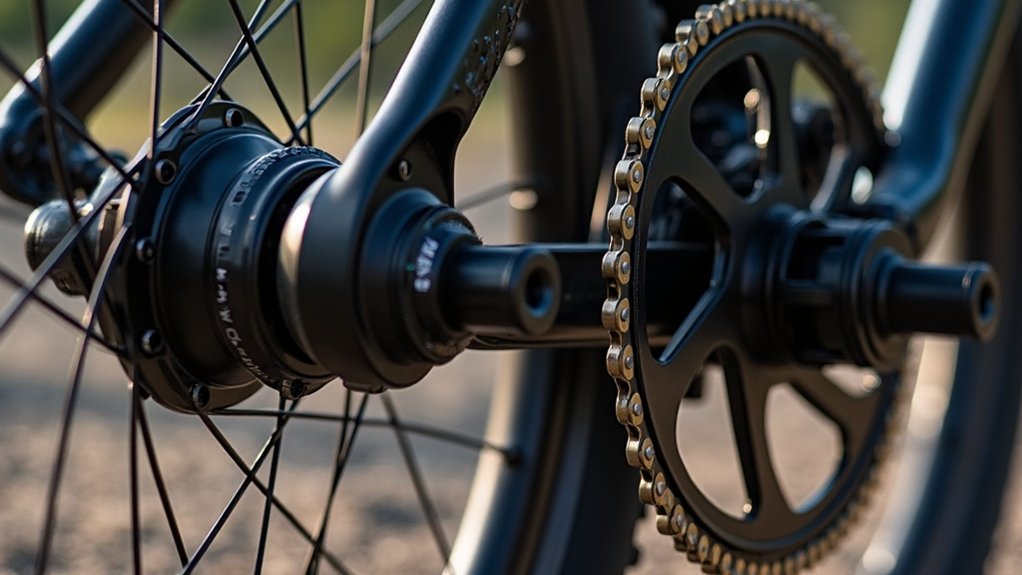
To maintain hub motors, focus on routine tasks like cleaning components, securing axle nuts, and re-greasing internal gears every 500–1,000 miles. In contrast, mid-drive systems require more attention, including regular chain lubrication and replacement every 1,500 to 3,000 miles. Mid-drive components wear out faster, leading to higher overall maintenance costs. Hub motors are generally easier to maintain, making them more user-friendly. Explore further to understand specific maintenance protocols for each system and their benefits.
Key Takeaways
- Hub motors require re-greasing of internal planetary gears every 500–1,000 miles, while mid-drive systems need more frequent chain and cassette replacements.
- Regular cleaning and securing of axle nuts are essential for hub motors, whereas mid-drive systems necessitate chain lubrication and derailleur inspections.
- Hub motors incur 30-50% lower maintenance costs due to less frequent upkeep compared to mid-drive systems, which have higher component wear.
- Mid-drive systems require specialized tools for repairs, whereas hub motors allow easier access for routine maintenance tasks.
- Tire changes are more complex for hub motors, while mid-drive systems facilitate simpler tire changes with less wiring interference.
Overview of Hub Motor Maintenance
When it comes to maintaining hub motors, you’ll find the process is particularly straightforward. Hub motors require low maintenance, primarily focusing on routine upkeep.
You’ll need to clean and secure axle nuts while checking wiring periodically. Re-greasing internal planetary gears every 500–1,000 miles guarantees peak performance.
Since hub motors operate independently of the chain, they greatly reduce wear on drivetrain components, extending their lifespan. While basic maintenance tasks can often be performed by you, professional servicing may be necessary for complex repairs.
Key Maintenance Tasks for Mid-Drive Systems
While hub motors offer straightforward maintenance, mid-drive systems present unique challenges that require more attention.
To guarantee peak performance, focus on these key maintenance tasks:
- Chain Replacement: Replace the chain every 1,500 to 3,000 miles to combat wear from the motor’s torque output.
- Lubrication: Regularly lubricate the chain, cassette, and derailleur to maintain shifting efficiency and prevent premature wear.
- Drivetrain Inspections: Routinely check drivetrain connections for misalignment, which can exacerbate wear issues.
Cleaning and upgrading to a stronger chain can further enhance maintenance efficiency, guaranteeing the longevity of your mid-drive system’s moving parts.
Comparing Maintenance Frequency: Hub vs. Mid-Drive
Though hub motors simplify maintenance with less frequent tasks, mid-drive systems demand a more hands-on approach due to their intricate integration with the bicycle’s drivetrain.
Hub motors require maintenance every 500–1,000 miles, focusing on cleaning and securing components, while mid-drive systems may necessitate 25-40% more attention.
Chains on mid-drive systems often need replacement every 1,500 to 3,000 miles, and cassettes typically last 3,000 to 5,000 miles, greatly affecting maintenance frequency.
This increased drivetrain wear leads to higher maintenance costs, impacting your overall riding experience.
Hub motors, in contrast, offer a more straightforward, efficient power delivery with longer-lasting components.
Cost Implications of Maintenance for Each System
When considering long-term maintenance costs, you’ll find that hub motors typically demand 30-50% less in expenses compared to mid-drive systems.
Mid-drive motors often require more frequent component replacements, such as chains and cassettes, which can greatly increase your overall budget.
Understanding these cost implications is essential for making an informed decision about your e-bike system.
Long-term Maintenance Costs
Understanding the long-term maintenance costs of hub motors versus mid-drive systems is essential for making an informed e-bike purchase.
- Hub motors incur 30-50% lower maintenance costs due to simpler designs.
- Mid-drive motors require frequent chain and cassette replacements, driving up expenses.
- Routine upkeep for hub motors is minimal, while mid-drive systems often need professional servicing.
Investing in a high-quality hub motor e-bike can be more cost-effective long-term, as it reduces repair costs and component failures.
With less wear on drivetrain components, you’ll find hub motors present a more economical choice for sustainable e-bike ownership.
Component Replacement Frequency
While hub motors offer a more straightforward maintenance experience, mid-drive systems present a challenge with their frequent component replacements. Hub motors typically incur 30-50% lower maintenance costs due to their independent operation, reducing wear on chains. In contrast, mid-drive motors require chain replacements every 1,500 to 3,000 miles and cassettes every 3,000 to 5,000 miles, leading to higher long-term expenses.
| System Type | Component Replacement Frequency |
|---|---|
| Hub Motors | Minimal (every 500-1,000 miles) |
| Mid-Drive Motors | High (chains every 1,500-3,000 miles) |
Ultimately, the maintenance requirements for mid-drive systems can notably increase repair costs.
Repair Difficulties Associated With Mid-Drive Motors
Repairing mid-drive motors presents unique challenges that can complicate maintenance and service. The integration with the bicycle’s drivetrain increases moving parts, leading to:
- Frequent chain replacements every 1,500 to 3,000 miles.
- Costly repairs due to drivetrain wear from misalignment and improper gear shifts.
- Higher torque output that may snap chains, necessitating immediate repairs.
These factors highlight the repair difficulties associated with mid-drive motors.
You’ll need specialized tools and knowledge for internal repairs, making them more complex to service compared to hub motors.
Regular maintenance is crucial to prevent costly repairs and guarantee your e-bike motor functions at peak performance.
Impact of Motor Placement on Maintenance Needs
The placement of hub motors at the wheel offers centralized weight distribution, which enhances stability and reduces drivetrain stress.
This isolation minimizes wear on components, allowing for lower maintenance frequency compared to mid-drive systems that directly impact the bike’s gears.
Additionally, the accessibility of hub motors simplifies maintenance tasks, making it easier for you to keep your system in peak condition.
Centralized Weight Distribution Benefits
When considering electric bike performance, the placement of the motor plays an essential role in weight distribution, greatly influencing maintenance needs.
- Mid-drive motors enhance stability and traction, particularly on steep inclines, but they increase wear on chains and drivetrain components.
- Hub motors reduce drivetrain stress, leading to lower maintenance needs, but may compromise stability due to unbalanced weight distribution.
- Centralized weight distribution from mid-drive motors allows for efficient power distribution, yet this can complicate maintenance due to the more frequent replacement of worn parts.
Your riding style ultimately determines the impact of these factors on your maintenance requirements.
Drivetrain Stress Isolation
Motor placement directly influences drivetrain stress isolation, which substantially affects maintenance needs for electric bikes.
Hub motors, located in the wheel hub, operate independently of the bike’s chain, leading to reduced wear on the chain and other components. This isolated placement results in lower maintenance frequency and extends the mechanical life of parts.
In contrast, mid-drive motors are mounted at the crankset, integrating with the bike’s gearing system, which increases drivetrain stress and accelerates wear. While they enhance performance, the complexity of mid-drive systems requires more frequent repairs and adjustments due to the additional moving parts involved.
Maintenance Accessibility Comparison
A comparison of maintenance accessibility between hub and mid-drive motor systems reveals significant differences influenced by their respective placements.
- Hub motors isolate from drivetrain stress, requiring less maintenance and simpler upkeep.
- Mid-drive motors integrate with the drivetrain, leading to increased wear on chains and components, demanding more frequent tuning.
- Tire changes for hub systems can complicate due to wiring disconnection, while mid-drive systems allow easier access to standard bicycle parts.
Best Practices for E-Bike Maintenance
To keep your e-bike running smoothly, understanding maintenance practices tailored to your system is essential. Hub motors demand minimal upkeep, focusing on cleaning components, securing axle nuts, and re-greasing internal gears every 500–1,000 miles. In contrast, mid-drive motors require more frequent chain replacement every 1,500 to 3,000 miles and regular lubrication to maintain drivetrain performance. Routine inspections of wiring connections are vital for both systems. Tire changes can be more complex for hub motors, while mid-drive motors simplify this process.
| Task | Hub Motors |
|---|---|
| Cleaning Components | Every 500–1,000 miles |
| Chain Replacement | Not applicable |
| Inspections | Regularly inspect wiring |
| Tire Changes | More complex due to wiring |