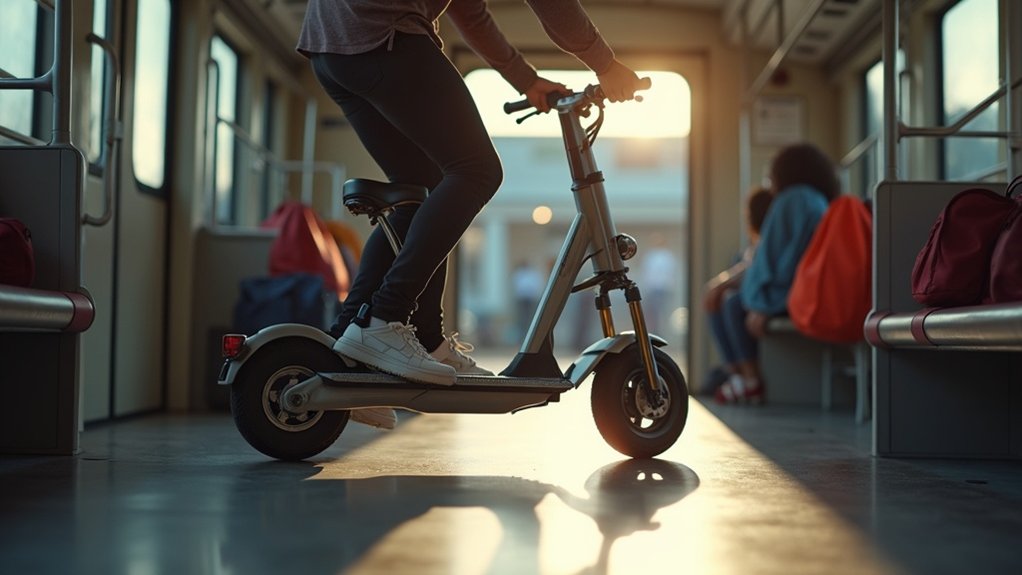
To lift scooters into luggage racks without strain, use proper body mechanics: bend your knees and keep your back straight. Engage your core and keep the scooter close to your body. If it feels heavy, consider using a ramp to reduce strain. Team lifting can also help; communicate with your partner and coordinate your movements. Always secure the scooter properly for transport. Keep going to discover more effective techniques and tips for safe loading and unloading.
Key Takeaways
- Bend at your knees and keep your back straight to maintain proper body mechanics while lifting the scooter.
- Use a ramp with a gentle incline to simplify loading and reduce physical strain.
- Engage core muscles for stability and keep the scooter close to your body during the lift.
- Communicate clearly with a partner and coordinate movements for effective team lifting.
- Secure the scooter with multiple tie-down straps in an “X” pattern to ensure stability during transport.
Understanding the Weight and Design of Mobility Scooters
When you’re considering lifting your mobility scooter into a luggage rack, understanding its weight and design is essential.
Most mobility scooters weigh no more than 57 lbs, making them manageable. Look for models with lightweight frames and compact folding mechanisms, designed for easy transport.
Travel scooters are typically portable, allowing you to load them into luggage racks without excessive strain. Additionally, many scooters feature a low center of gravity, stabilizing them during lifting and reducing tipping risks.
Always check the weight capacity and dimensions of both the scooter and the luggage rack to guarantee safe lifting.
Proper Body Mechanics for Lifting
Understanding how to lift your mobility scooter safely is just as important as knowing its weight and design.
Always bend at your knees and keep your back straight to maintain proper body mechanics and reduce strain. Engage your core muscles to enhance stability and guarantee proper weight distribution.
Keep the scooter close to your body while lifting, as this minimizes leverage and injury risk. Use a wide stance with your feet shoulder-width apart for better balance.
If the scooter feels too heavy or awkward, don’t hesitate to ask for assistance or use a ramp to make the lift easier.
Using Ramps for Easier Loading
Using a ramp can make loading your mobility scooter into luggage racks considerably easier and safer. Choose ramps specifically designed for transporting scooters, ensuring they’ve a weight capacity that exceeds your scooter’s weight.
Position the ramp at a gentle incline to reduce strain while loading. Look for ramps with textured surfaces to enhance traction for both your scooter wheels and yourself, ensuring a secure grip.
If possible, practice loading techniques with a partner for added support and balance. This approach not only simplifies the process but also minimizes the risk of injury during loading.
Tips for Team Lifting With Assistance
Ramps can make it easier to load your scooter, but sometimes you’ll need a little extra help.
For effective team lifting, clear communication is key. Coordinate your movements to lift simultaneously, reducing the risk of physical strain. Use proper lifting techniques: bend at your knees and keep your back straight.
Clear communication and proper lifting techniques are essential for effective team lifting, ensuring safety and reducing strain.
Stand close to the scooter, ensuring a proper grip with both hands for control. One person should tilt the scooter slightly while the other supports the weight, making the process smoother.
This teamwork, combined with a ramp for ease of use, will make loading scooters into luggage racks much easier.
Ensuring Stability During Transport
When you’re transporting a scooter, stability is essential to guarantee a smooth journey.
Always use a sturdy ramp for loading and unloading, minimizing strain. Position the scooter’s front wheel against the luggage rack to prevent rolling.
Secure the scooter using multiple tie-down straps in an “X” pattern to distribute weight evenly, enhancing stability during transport.
It’s wise to involve a second person for balance and guidance, which can greatly reduce the risk of injury.
Finally, regularly check the tightness of the straps and the scooter’s overall stability to avoid shifting or damage while you’re on the road.