To estimate your e-bike range for a specific route, start by looking at your battery capacity in watt-hours (Wh) and the motor power. Generally, calculate range using the formula: Range (miles) = Battery Capacity (Wh) ÷ Energy Use (Wh/mile). Consider rider weight, terrain, and environmental factors, as they impact energy consumption. By factoring in these elements, you’ll get a more accurate estimate. There’s more to understand about optimizing your e-bike journey.
Key Takeaways
- Calculate the range using the formula: Range (miles) = Battery Capacity (Wh) ÷ Energy Use (Wh/mile).
- Consider your battery capacity, as higher watt-hours offer longer potential range.
- Factor in rider weight and cargo, as additional weight can reduce range by 5-10%.
- Assess terrain type; hills can significantly increase energy consumption compared to flat ground.
- Utilize online range calculators for tailored estimates based on your specific conditions.
Understanding Battery Capacity and Watt-Hours
When it comes to estimating your e-bike’s range, understanding battery capacity measured in watt-hours (Wh) is essential.
This measurement, calculated by multiplying voltage (V) by amp-hours (Ah), reveals the total energy stored. For example, a 36V battery with 10Ah equals 360Wh.
Higher watt-hour ratings typically translate to greater potential range; a 500Wh battery can allow for about 20-25 miles under moderate conditions.
Real-world consumption averages 15-30Wh per mile, making watt-hours vital for accurate range estimates.
Prioritizing watt-hours over amp-hours offers a clearer picture of your e-bike’s energy potential, ensuring you’re well-prepared for your ride.
Calculating Potential Range Based on Motor Power
To accurately calculate your e-bike’s potential range, you’ll need to take into account the motor power, which directly impacts energy consumption.
Typically, low-power e-bikes (250W) average 15-20Wh per mile, while high-power models (750W+) can consume around 30Wh per mile.
To estimate potential range, divide your battery’s energy capacity in watt-hours (Wh) by the expected energy use per mile based on motor power.
For instance, a 500Wh battery on a mid-power e-bike might yield a range of 20-25 miles.
Factors Influencing E-Bike Range Estimates
Estimating an e-bike’s range isn’t solely about motor power and battery capacity; various factors come into play that can greatly alter your expected distance per charge.
Consider these elements:
- Battery Capacity: Measured in watt-hours (Wh), higher capacity allows for longer rides.
- Rider Weight: Every additional 20 pounds can reduce range by 5-10% on flat terrain.
- Terrain Type: Flat ground uses around 10-15Wh per mile, while steep hills can double that.
- Pedal Assistance Level: Higher levels drain the battery faster, while lower levels help conserve power.
Understanding these factors helps refine your range estimates.
Practical Tips for Accurate Range Estimation
Accurate range estimation requires a methodical approach to various influencing factors.
Start by applying the basic formula: Range (miles) = Battery Capacity (Wh) ÷ Energy Use (Wh/mile). On flat terrain, expect around 10Wh/mile.
Consider your riding style and cargo weight; every additional 20 pounds can reduce range by 5-10%.
Terrain plays a vital role—hills can double energy use.
Don’t overlook environmental conditions like wind and cold, which can cut range by 20-50%.
Finally, utilize online calculators and reduce manufacturer stated ranges by 20% for realistic estimates.
This thorough approach guarantees more accurate range predictions for your journey.
Utilizing Online Range Calculators for Precision
While riding an eBike offers a thrilling experience, knowing your range can be essential for planning your routes effectively.
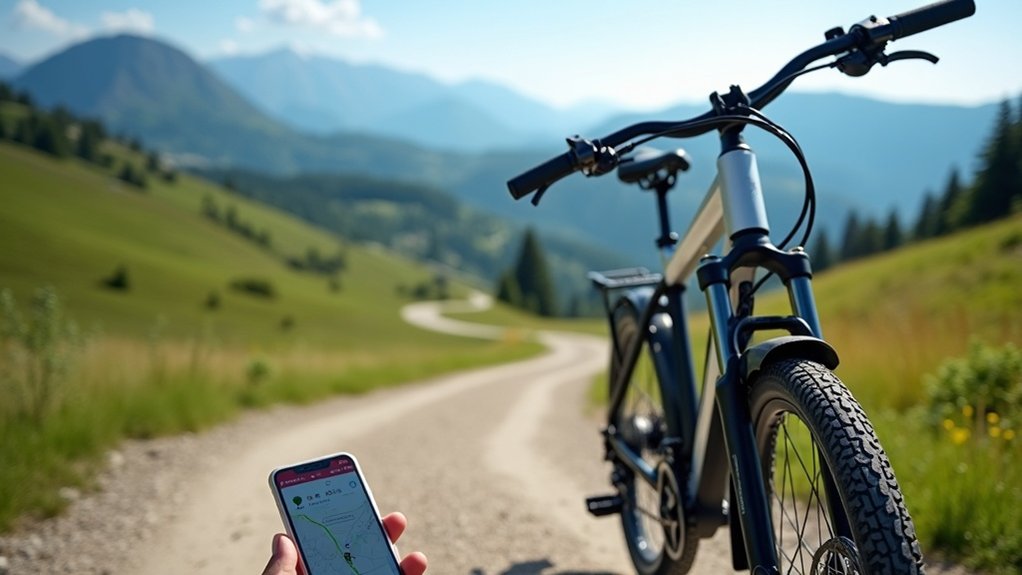
Utilizing an eBike range calculator can provide tailored estimates based on vital factors. Here’s how to optimize your calculations:
- Input Battery Capacity: Enter your battery’s voltage and amp-hour ratings.
- Consider Rider and Cargo Weight: Factor in your weight along with any additional load.
- Account for Terrain Type: Different terrains affect efficiency.
- Evaluate Real-World Conditions: Include wind and elevation changes for realistic projections.