
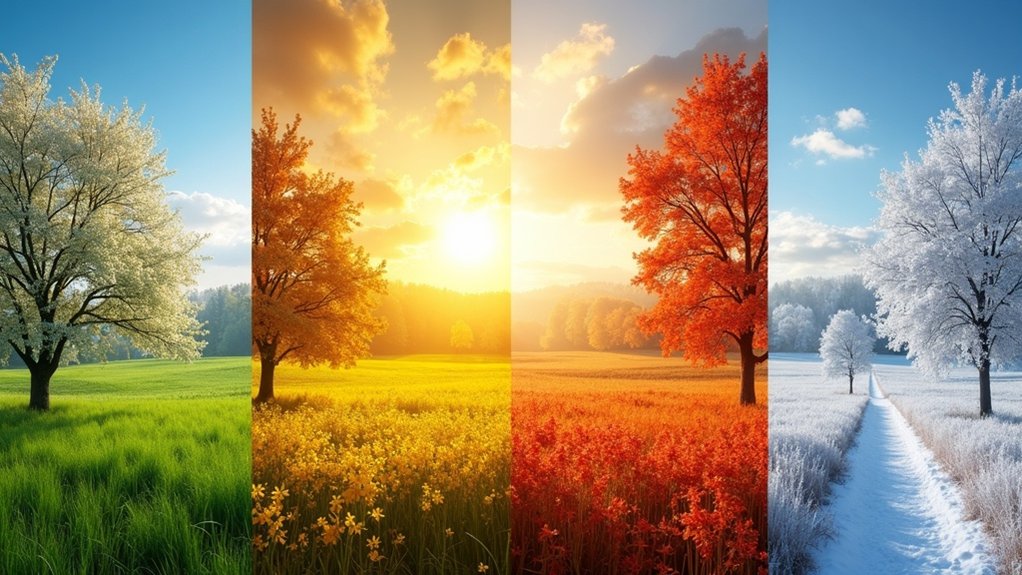
To compare real-world ranges across seasons, you must consider how weather patterns, climate types, and human actions interact. Each season brings unique temperature and precipitation changes, affecting agricultural practices and lifestyle choices. For example, tropical regions stay warm, while polar areas face harsh winters limiting farming. Earth’s axial tilt influences these seasonal variations, altering ecosystems and daily routines. By understanding these dynamics, you can better grasp how our environment shifts with each season, revealing deeper insights ahead.
Key Takeaways
- Seasonal changes influence temperature ranges, with summer being warmer and winter colder in temperate climates compared to polar and tropical climates.
- Agricultural productivity varies with seasons, as crops are planted and harvested based on temperature and precipitation patterns.
- Climate zones dictate seasonal weather variations, affecting how different regions experience and adapt to temperature fluctuations throughout the year.
- Human activities, such as urbanization and farming, impact local climate conditions, altering seasonal temperature ranges and precipitation patterns.
- Extreme weather events, intensified by climate change, can disrupt typical seasonal patterns, leading to unexpected temperature and precipitation variations.
Understanding Weather and Climate
While many people often conflate weather and climate, understanding the distinction between the two is essential for grasping how our environment operates. Weather encompasses short-term atmospheric conditions like temperature and precipitation, while climate represents long-term averages in specific regions.
Various factors, such as latitude, terrain, and proximity to water, influence distinct climate patterns. The Earth’s axial tilt also creates seasonal variations, impacting both weather and climate.
Importantly, climate changes driven by human activities, including fossil fuel combustion, greatly alter weather patterns. Events like El Niño further disrupt local weather, demonstrating the interconnectedness of global climate systems.
Exploring Types of Climates
When you explore climate types, you’ll find that each has unique characteristics shaped by temperature and precipitation.
Polar, tropical, and temperate climates not only define weather patterns but also influence ecosystems and human activities throughout the year.
Understanding these variations is vital for grasping how our environment adapts across seasons.
Climate Types Overview
Understanding the diverse climate types on Earth is essential for grasping how they shape ecosystems and human activities. The main climate types include polar, tropical, and temperate, each influencing the environment differently.
| Climate Type | Characteristics |
|---|---|
| Polar | Cold temperatures, long winters |
| Tropical | Hot, humid, high biodiversity |
| Temperate | Four seasons, moderate climate |
Polar regions host cold-adapted species, while tropical climates support diverse flora. Temperate zones, experiencing four distinct seasons, enable varied agricultural practices, highlighting the importance of latitude in climate variation.
Seasonal Climate Variations
Seasonal climate variations considerably impact ecosystems and human activities, as the Earth’s axial tilt creates diverse weather patterns throughout the year.
Understanding these variations helps you adapt and thrive in different environments. Here are some key points:
- The Northern Hemisphere enjoys summer when tilted towards the Sun.
- Tropical regions near the equator maintain high temperatures year-round.
- Polar climates experience long, cold winters with minimal sunlight.
- Temperate zones showcase four distinct seasons with unique patterns.
- Oceanic influences moderate temperatures, leading to milder changes in coastal areas.
Seasonal Changes and Earth’s Tilt
You’ll notice that Earth’s axial tilt of about 23.5 degrees markedly impacts seasonal temperature variations.
As this tilt alters the angle and intensity of sunlight, you experience distinct seasons depending on your geographical location.
This phenomenon not only affects temperature and daylight duration but also influences ecosystems and agricultural practices across the globe.
Earth’s Axial Tilt Effects
As Earth’s axial tilt of approximately 23.5 degrees plays a critical role in shaping our climate, it directly influences the distribution and intensity of sunlight received across different latitudes throughout the year.
This tilt results in:
- Seasonal changes, with the Northern and Southern Hemispheres experiencing opposite seasons.
- Varied daylight duration, causing extremes near the Arctic Circle.
- Increased solar energy during summer, leading to warmer temperatures.
- Unique climate patterns that foster diverse ecosystems.
- Adaptations in agricultural practices based on local sunlight availability.
Understanding these effects of axial tilt can help you appreciate the complexities of our planet’s climate system.
Seasonal Temperature Variations
The effects of Earth’s axial tilt extend beyond just the distribution of sunlight; they considerably shape temperature variations across the seasons. This tilt of approximately 23.5 degrees causes different areas to receive varying sunlight amounts, leading to pronounced seasonal temperature variations.
For instance, during summer in the Northern Hemisphere, sunlight intensifies, resulting in warmer temperatures, while the Southern Hemisphere cools down. Conversely, when the Southern Hemisphere enjoys its summer, the Northern Hemisphere experiences winter.
Additionally, latitude plays an essential role, with equatorial regions generally warmer than polar areas. Therefore, Earth’s tilt and orbit drive significant climate patterns globally year-round.
Factors Influencing Climate Variability
Understanding climate variability requires examining several key factors that shape the environment.
These elements interact to influence how climates change across different regions and seasons:
- Latitude: Warmer temperatures near the equator versus colder polar climates.
- Axial Tilt: Seasonal changes due to varying sunlight distribution.
- Terrain and Altitude: Cooler temperatures at higher elevations create microclimates.
- Proximity to Water: Large bodies of water moderate local temperatures.
- Human Activities: Deforestation and fossil fuel use increase greenhouse gases, altering long-term climate patterns.
These factors help you grasp the complex nature of climate variability and its impacts on your surroundings.
The Role of Oceans in Climate Moderation
Climate variability is markedly influenced by oceanic processes, which play a pivotal role in moderating temperatures across the globe. Oceans, with their high heat capacity, absorb and store heat, resulting in milder seasonal changes compared to land areas.
In the Southern Hemisphere, the extensive bodies of water reduce extreme temperature fluctuations, unlike the Northern Hemisphere. Ocean currents, such as the warm Gulf Stream, redistribute heat and shape regional climates.
Additionally, large bodies of water delay seasonal temperature shifts, leading to cooler summers and milder winters in coastal regions. Variations in ocean temperatures also affect atmospheric conditions, influencing global weather patterns.
Climate Change and Its Impact
As human activities continue to amplify greenhouse gas emissions, the consequences of climate change become increasingly evident.
Human activities are intensifying greenhouse gas emissions, making the consequences of climate change more apparent than ever.
You may notice the following impacts of global warming:
- Average global temperatures have risen by about 1.2 degrees Celsius since the late 19th century.
- Spring is arriving earlier, while winters are milder in many regions.
- The Arctic is warming nearly twice as fast as the global average.
- Extreme weather events are occurring more frequently.
- Climate variability, like El Niño and La Niña, intensifies local weather impacts.
These changes affect ecosystems and agricultural practices, highlighting the urgent need for action against climate change.
Human Contributions to Climate Change
Human activities have markedly accelerated climate change, driving the alarming trends observed in our environment.
In both the North and South, burning fossil fuels for transportation and industrial processes releases vast amounts of carbon dioxide, a primary greenhouse gas. Deforestation, spurred by agriculture and urbanization, further diminishes tree populations that naturally absorb CO2.
The transportation sector contributes nearly 29% of U.S. greenhouse gas emissions, underscoring everyday commuting’s impact. Additionally, agricultural practices, particularly livestock and rice production, add about 14% to global emissions through methane release.
These human contributions to climate change intensify extreme weather patterns and disrupt ecosystems worldwide.
Seasonal Effects on Agriculture and Lifestyle
While the Earth’s axial tilt dictates the rhythm of the seasons, its effects extend far beyond the changing landscape; they profoundly impact agriculture and lifestyle.
Seasonal changes dictate how and when you engage with your environment, influencing:
Seasonal changes shape our interactions with the environment, guiding everything from agriculture to lifestyle choices.
- Crop planting and harvesting cycles
- Adaptation to climate variations, like droughts or floods
- Food consumption patterns, with seasonal ingredients
- Clothing styles and housing designs for comfort
- Overall lifestyle choices based on weather conditions
In temperate regions, spring and summer are prime for growth, while polar climates restrict agricultural activities, showcasing nature’s direct influence on our daily lives.