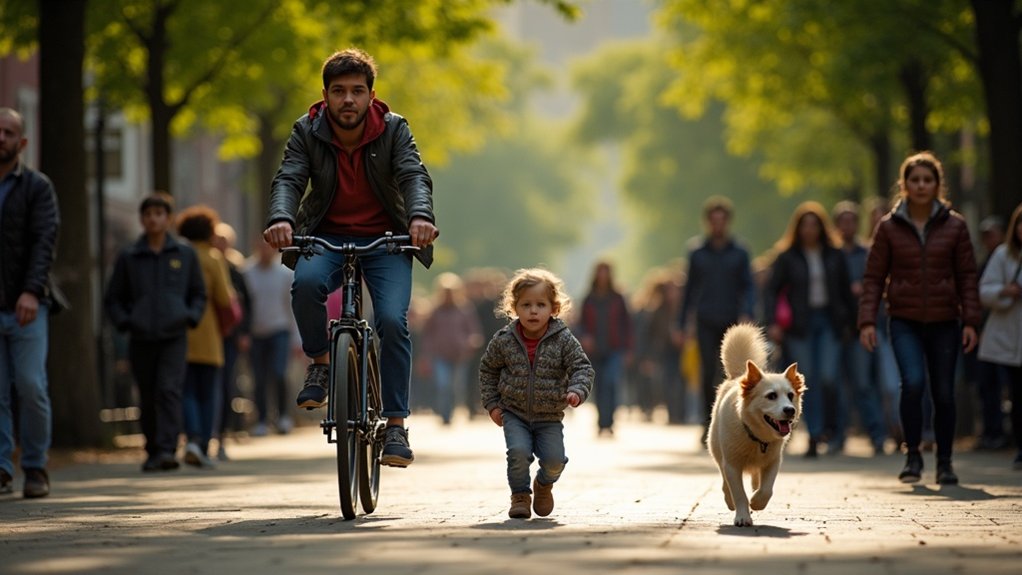
To balance speed and safety on crowded paths, enhance your awareness by scanning the environment 6-10 feet ahead, while practicing mindful breathing to stay focused. Implement effective traffic calming measures like lower speed limits and dedicated bike lanes in your community. Encourage collaboration with local authorities to address unique safety needs. Also, prioritize agility drills at home to prepare for unexpected movements. Stay engaged, and you’ll uncover more strategies to guarantee safer navigation in bustling spaces.
Key Takeaways
- Maintain a balanced stance to enhance stability and reduce the risk of falls in crowded environments.
- Scan the area 6–10 feet ahead to improve reaction time and awareness of surroundings.
- Utilize mindful breathing techniques to stay calm and focused amid chaotic settings.
- Engage in agility drills and balance practice at home to prepare for unexpected nudges.
- Collaborate with community members to implement traffic calming measures, enhancing safety for all road users.
Understanding the Importance of Balance in Crowded Spaces
When maneuvering crowded spaces, understanding the importance of balance is essential for your safety and efficiency. A balanced stance with feet shoulder-width apart and knees slightly bent enhances stability, reducing fall risk.
By scanning the environment 6–10 feet ahead, you can anticipate obstacles, improving your reaction time. Practicing diaphragmatic breathing calms your demeanor, leading to steadier movements.
Additionally, engaging in agility drills at home prepares you for unexpected bumps, while training in chaotic settings enhances your awareness.
These strategies not only improve your balance but also contribute to overall traffic safety, making crowded paths safer for everyone and helping to improve road conditions.
The Role of Speed Limits in Enhancing Safety
Speed limits play an essential role in enhancing pedestrian safety by directly influencing the likelihood and severity of accidents.
When you adjust speed limits to match crowded conditions, you can markedly reduce the risks for vulnerable road users.
Examining the data reveals that even slight reductions in speed can lead to substantial improvements in safety outcomes.
Impact on Pedestrian Safety
Although you mightn’t always think about it, speed limits are an essential factor in enhancing pedestrian safety on crowded paths. By setting speed limits, cities can greatly reduce traffic fatalities and improve safety outcomes.
For instance, lowering speed limits from 25 mph to 20 mph has been associated with a 46% reduction in collisions in London. The survival rate for pedestrians diminishes drastically with speed; at 20 mph, it’s 95%, while at 30 mph, it drops to 55%.
Traffic engineers advocate for these limits as protective measures, emphasizing their role in minimizing stopping distances and enhancing decision-making time for drivers.
Adjusting Limits for Conditions
Adjusting speed limits according to specific conditions can markedly enhance safety for pedestrians and drivers alike.
For instance, lowering the limit from 25 mph to 20 mph in urban areas can lead to a 46% reduction in collisions, as seen in London. At 20 mph, stopping distances decrease considerably, allowing more reaction time to avoid crashes.
Traffic engineers rely on extensive data to set these limits, balancing safety with efficiency. Implementing lower speed limits in crowded or high-risk zones accommodates human error, ultimately reducing traffic fatalities and serious injuries, which is essential for creating safer pathways for everyone.
Effective Traffic Calming Measures
To guarantee safe navigation on crowded paths, implementing effective traffic calming measures is essential. These strategies considerably enhance safety and reduce accidents. Here’s a quick overview:
| Measure | Impact on Safety |
|---|---|
| Speed Cameras | Reduces severe crashes by up to 78% |
| Road Diets | Decreases overall crashes by 47% |
| High-Friction Surfaces | Lowers wet road crashes by 52% |
| Backplates on Traffic Signals | Improves visibility, reducing crashes by 15% |
| Auxiliary Turn Lanes | Cuts left-turn crashes by up to 48% |
Strategies for Maintaining Awareness and Focus
To navigate crowded paths safely, you need to enhance your environmental scanning by looking 6–10 feet ahead and side-to-side.
Practicing mindful breathing techniques can also help maintain focus and calm your nerves amid chaos.
These strategies not only improve your awareness but also prepare you for unexpected obstacles, making your journey smoother and safer.
Enhance Environmental Scanning
While traversing crowded paths, enhancing your environmental scanning is essential for safety and efficiency. Focus on scanning 6–10 feet ahead rather than just your feet; this foresight helps you anticipate obstacles.
Incorporate side-to-side scanning to gather vital spatial data, improving navigation through high-traffic areas. Stay alert and maintain a calm demeanor to react swiftly to unexpected stops or bumps from others.
Additionally, practicing balance skills at home prepares you for unintentional nudges, ensuring safety for everyone. Engaging in walking meditation can sharpen your focus and awareness, empowering you to navigate busy paths without feeling overwhelmed.
Practice Mindful Breathing Techniques
Practicing mindful breathing techniques greatly enhances your awareness and focus as you navigate crowded paths. By inhaling for 3-4 steps and exhaling for the next 3-4, you establish a rhythmic pattern that steadies your gait.
This diaphragmatic breathing calms your nervous system, reducing distractions and minimizing accident risks. Incorporating walking meditation techniques sharpens your concentration, encouraging a more attentive approach.
Controlled breathing exercises counteract shallow breaths that create tension and jerky movements. Regular practice trains your brain to remain calm and centered, facilitating quicker recovery from unexpected bumps or stumbles, ultimately balancing speed and safety in busy environments.
The Impact of Human Behavior on Safety
Human behavior plays an essential role in traffic safety, as errors made by drivers often lead to accidents that could otherwise be avoided. Understanding these behaviors can help improve safety for everyone.
- Human error contributes greatly to traffic accidents.
- Pedestrian survival rates drop dramatically with increased vehicle speed.
- Education alone isn’t enough to eliminate driving errors.
- Tailored safety designs can greatly enhance community safety.
Traffic engineers must develop systems that account for these behaviors. Implementing speed cameras and traffic calming measures can mitigate human error, reducing severe crashes by up to 78% in high-risk areas.
Innovative Design Solutions for Pedestrian Safety
To enhance safety for pedestrians, innovative design solutions must be prioritized alongside behavioral considerations. Implementing features like plastic pedestrian barriers can separate foot traffic from vehicles, while high-friction surface treatments can reduce wet road crashes by 52%. Additionally, backplates on traffic signals improve visibility, and traffic calming measures like road diets can lower overall crashes by up to 47%. Clear signage on busy paths is essential for warning drivers.
| Design Solution | Safety Impact |
|---|---|
| Plastic Barriers | Separates pedestrians from traffic |
| High-Friction Treatments | Reduces wet road crashes by 52% |
| Traffic Calming Measures | Decreases crashes by up to 47% |
Community Involvement in Traffic Safety Initiatives
As communities face increasing traffic safety challenges, engaging residents in proactive discussions proves essential for effective solutions. Here are key aspects to reflect upon:
- Identifying specific community needs for tailored safety measures
- Implementing traffic calming measures like lower speed limits and bike lanes
- Collaborating with local governments, traffic engineers, and advocates
- Encouraging public feedback to shape traffic safety policies
Active participation in safety initiatives, such as neighborhood watch programs and workshops, fosters a culture of shared responsibility.
This collective effort not only addresses local safety concerns but also promotes awareness among all road users, ultimately balancing speed and safety on crowded paths.
The Future of Balancing Speed and Safety in Urban Planning
While urban planning evolves to address the complex dynamics of growing populations and increased traffic, balancing speed and safety remains a top priority.
Traffic calming measures, like lower speed limits and dedicated bike lanes, are essential for enhancing pedestrian safety while accommodating commuters. Research shows that reducing speed limits from 25 mph to 20 mph can cut collisions by 46%.
Innovative solutions, such as reversible roadways, maximize capacity during peak hours without sacrificing safety.
Collaboration among city officials, traffic engineers, and community advocates is key to tailor strategies that effectively balance speed and safety, ensuring urban environments meet diverse needs.