To avoid pinch flats on curbs, keep your tire pressure at ideal levels—90-100 psi for rear tires and 80-90 psi for front tires. Choose wider tires for better impact absorption, and consider tubeless options to reduce pinch risks. When riding, maintain a balanced position, stand on the pedals to absorb shocks, and lift your front wheel when approaching curbs. With regular tire inspections and maintenance, you can further enhance your ride’s safety and performance. There’s more you can do to improve this process.
Key Takeaways
- Maintain proper tire pressure (90-100 psi rear, 80-90 psi front) to reduce pinch flat risk.
- Choose wider tires (25mm or 28mm) for better impact absorption and reduced pinch flat likelihood.
- Stand on pedals when approaching curbs to absorb shocks and minimize impact on tires.
- Keep your weight back and lift the front wheel when hitting curbs to lessen compression.
- Regularly inspect tires for damage and ensure proper rim tape condition to prevent flats.
Understanding Pinch Flats and Their Causes
When you hit a curb or obstacle with low tire pressure, you risk experiencing a pinch flat, a common issue for cyclists.
Pinch flats occur when the tube compresses between the tire and rim, leading to two punctures, often termed snake bites. Insufficient air pressure is a primary cause, with ideal inflation around 90-100 psi for rear tires and 80-90 psi for front tires for riders up to 190 pounds.
Narrower tires increase the risk of pinch flatting due to reduced air volume. To mitigate this, consider using wider tires, which provide better impact absorption and enhance your road bike’s performance.
Maintaining Proper Tire Pressure
Proper tire pressure plays an essential role in preventing pinch flats, especially when maneuvering through urban environments with curbs and obstacles. Under-inflated tires increase the risk of pinch flats, so it’s vital to maintain ideal inflation pressure. For a 25c tire, aim for 90-100 psi in the rear and 80-90 psi in the front. Regularly check your tire pressure before rides to confirm they’re within this range. Experimenting with slightly higher pressures, around 5 psi below the maximum rating, can help you avoid pinch scenarios.
| Tire Type | Recommended Pressure (psi) | Notes |
|---|---|---|
| Front | 80-90 | Ideal for comfort |
| Rear | 90-100 | Enhances load capacity |
| Tubeless | Varies | Check manufacturer’s specs |
| Regular | Monthly | Maintain to avoid pinch flats |
Choosing the Right Tires for Your Setup
Choosing the right tires for your setup is essential for minimizing the risk of pinch flats, especially in urban environments where curbs and obstacles are common.
Opt for wider tires, like 25mm or 28mm, as they provide more air volume and better absorb impacts. Stiffer sidewalls can prevent tube pinch during hard hits by reducing the chance of the tube getting trapped.
Consider tubeless tires, which eliminate pinch flats entirely, allowing lower tire pressure without sacrificing performance. Additionally, select puncture-resistant options to withstand impacts, and regularly check your tire pressure to make sure it stays within the recommended range for ideal safety.
Proper Riding Techniques to Minimize Impact
To minimize the impact of hitting curbs and obstacles, maintaining a balanced and upright position on your bike is essential.
Stand on the pedals as you approach, allowing your body to absorb shocks effectively. Always look ahead to spot curbs, adjusting your speed and route to avoid hard hits that could lead to a flat tire.
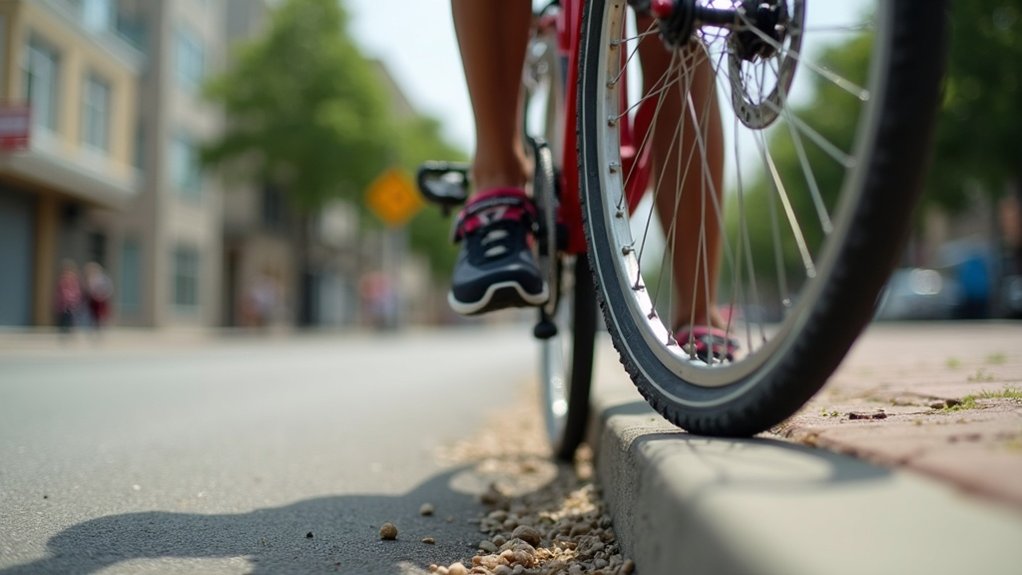
Keep your elbows and knees slightly bent, which enhances control and shock absorption. As you near a curb, shift your weight back and lift your front wheel slightly to reduce pinch impact on the tires.
Practice these techniques for smoother, more controlled riding.
Regular Tire Maintenance and Inspection Tips
While you’re focused on improving your riding techniques, don’t overlook the importance of regular tire maintenance and inspection.
Here are some essential tips to help reduce the risk of pinch flats:
- Regularly check tire pressure, aiming for 90-100 psi for rear tires.
- Inspect tires for cracks or embedded debris that could cause punctures.
- Verify rim tape is in good condition and properly seated.
- Use talcum powder on the tube and inside the tire during installation to reduce friction.
- Carry a repair kit and spare tubes, and learn quick repair techniques.
Keeping your tires in top shape is vital for a smooth ride.