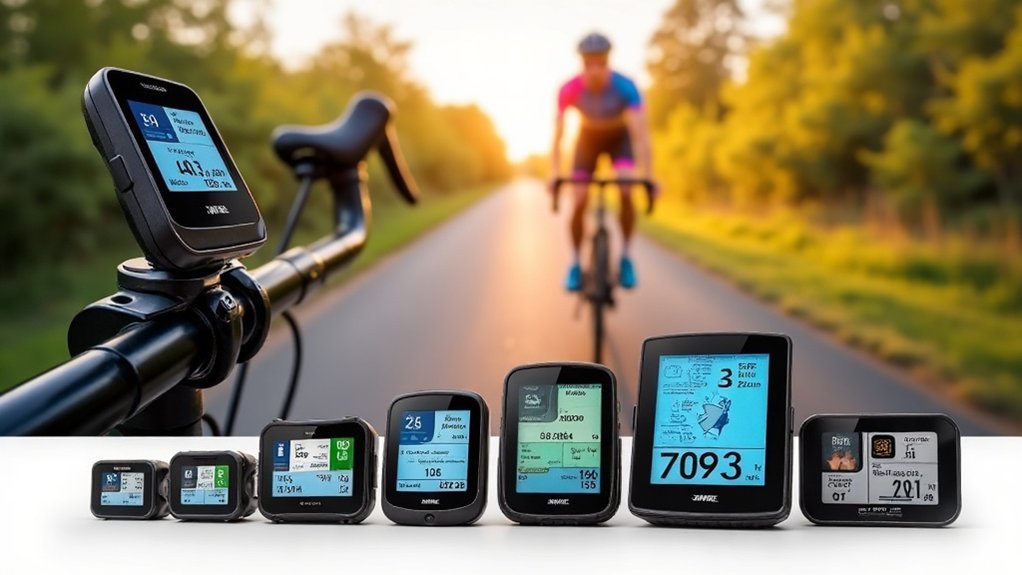
Cyclists seeking reliable performance and navigation can consider the seven best bike computers tailored specifically for e-bikes. Options like the iGPSPORT BSC200S and COOSPO Wireless GPS offer notable features such as GPS integration and Bluetooth connectivity, which are essential for electric bike riders.
The lightweight CYCPLUS G1 excels in battery life, making it a great companion for long-distance e-bike rides. For casual riders, Bikevee provides simplicity without overwhelming features.
Advanced users may prefer the COOSPO CS600’s touchscreen functionality for a more interactive experience. With various metrics and usability enhancements designed for electric bicycles, these devices cater to all types of e-bike enthusiasts.
Further insights await for those exploring their ideal choice.
iGPSPORT BSC200S GPS Bike Computer (Wireless, Waterproof)

The iGPSPORT BSC200S GPS Bike Computer is an excellent choice for e-bike enthusiasts seeking a reliable and feature-rich navigation tool. It allows users to create or import routes from popular platforms like Strava and Ride with GPS, enabling seamless navigation tailored for electric cycling. Smart notifications enhance the riding experience with turn reminders and incoming call alerts. The device supports a Last Ride function, storing up to 400 hours of data, including over 100 metrics. Its 2.4-inch semi-reflective screen ensures visibility, while a robust 600mAh battery lasts up to 25 hours, making it a dependable companion for any e-bike rider.
Best For: E-bike riders looking for a reliable and feature-rich GPS bike computer for navigation and data management.
Pros:
- Supports route creation and import from popular platforms like Strava and Ride with GPS.
- Offers over 100 metrics for comprehensive ride analysis, including speed, distance, and calories burned.
- Long battery life of up to 25 hours with quick charging via Type C port.
Cons:
- Limited visibility in low-light conditions despite the semi-reflective screen.
- Requires smartphone connectivity for full functionality of smart notifications.
- May have a learning curve for users unfamiliar with GPS navigation tools.
COOSPO Wireless GPS Bike Computer with Bluetooth

Cyclists seeking reliable performance will appreciate the COOSPO Wireless GPS Bike Computer with Bluetooth. This compact device, model BC107-B-L, features a 2.4-inch sunlight-readable screen and offers accurate GPS positioning with two global modes. Initial positioning may take 3-5 minutes outdoors. Its ANT+ connectivity supports various sensors, including heart rate monitors, while the CoospoRide App simplifies route loading and activity tracking. With an IP67 waterproof rating, it withstands rainy conditions. However, users should note that the Out Front Bike Computer Mount and additional sensors must be purchased separately for full functionality.
Best For: Cyclists seeking a reliable and feature-rich bike computer for tracking performance and navigation on e-bikes.
Pros:
- Accurate GPS positioning ensures precise data collection for cycling activities.
- ANT+ connectivity allows integration with heart rate monitors and other sensors for comprehensive metrics.
- IP67 waterproof rating provides durability in various weather conditions.
Cons:
- Initial GPS positioning may take 3-5 minutes, which could be inconvenient for quick rides.
- Out Front Bike Computer Mount is not included and must be purchased separately.
- Additional sensors are required for full functionality, leading to extra costs.
CYCPLUS Wireless GPS Bike Computer G1, 70g, 2.0″ Screen, IPX6, 1200mAh

For avid cyclists seeking reliable performance, the CYCPLUS Wireless GPS Bike Computer G1 stands out with its impressive features tailored for e-bikes. Weighing just 70g, it boasts a 2.0″ screen that utilizes FSTN technology for enhanced visibility. The dynamic GPS positioning guarantees accurate tracking of ride time, distance, and altitude, making it ideal for electric bike journeys. With a robust 1200mAh battery, it offers over 55 hours of use, while its IPX6 waterproof rating allows for operation in wet conditions without cable clutter. Additionally, the device includes a sleep mode and comes with a two-year warranty, providing peace of mind alongside its advanced functionalities.
Best For: E-bike enthusiasts seeking a lightweight and feature-rich bike computer for accurate ride tracking.
Pros:
- Dynamic GPS positioning ensures quick and precise tracking of ride metrics.
- Long-lasting battery with 1200mAh capacity provides over 55 hours of use.
- IPX6 waterproof rating allows for use in various weather conditions without issues.
Cons:
- Limited screen size may not display all data simultaneously for some users.
- Wireless connectivity might face interference in certain environments.
- Sleep mode may not be customizable for users who prefer different inactivity settings.
Bikevee Wireless GPS Bike Computer, 2.4″ Screen, 650mAh, IPX7

Bikevee Wireless GPS Bike Computer: The Essential Companion for E-Bike Enthusiasts
Designed for serious e-bike riders, the Bikevee Wireless GPS Bike Computer features robust GPS tracking capabilities. It monitors essential metrics such as current and average speed, riding distance, and total mileage, alongside altitude and temperature. The 2.4-inch LCD screen guarantees clear visibility, complemented by an automatic backlight for low-light conditions. Its simple, sensor-free setup eliminates complicated installations, while Auto Start and Stop functions enhance usability. With a rechargeable 650mAh battery providing up to 28 hours of use and an IPX7 waterproof rating, this bike computer is built to withstand various outdoor conditions, making it ideal for all e-bike adventures.
Best For: E-bike riders seeking a reliable and easy-to-use GPS bike computer to track their performance and metrics during rides.
Pros:
- Robust GPS tracking for essential cycling metrics like speed, distance, and altitude.
- User-friendly setup with no complicated sensors or cables required.
- Long battery life of up to 28 hours and an IPX7 waterproof rating for all-weather use.
Cons:
- Limited advanced features compared to more expensive models.
- Screen size may be small for users who prefer larger displays.
- Rechargeable battery may require frequent charging for long-distance e-bike riders.
COOSPO Color Touchscreen GPS Bike Computer CS600

The COOSPO Color Touchscreen GPS Bike Computer CS600 is designed for cyclists, making it less relevant for electric bicycles (e-bikes) or electric scooters (e-scooters). However, if you’re looking for a GPS solution tailored for e-bikes, this device offers an intuitive 2.4-inch high-resolution color touchscreen that enhances navigation for tech-savvy riders. With auto-backlight technology, it ensures visibility in varying light conditions.
Equipped with built-in route navigation, the CS600 provides clear on-screen mapping and a breadcrumb trail, helping riders avoid wrong turns. Utilizing GPS and GLONASS technology, it tracks speed, distance, and time with precision, offering over 150 performance insights. The device syncs wirelessly with the COOSPORIDE app, allowing users to manage their ride data effortlessly. Additionally, the IPX7 waterproof rating ensures it remains reliable in all weather conditions, enhancing the cycling experience.
Best For: Cyclists looking for a reliable and feature-rich GPS computer to enhance navigation and performance tracking.
Pros:
- High-resolution color touchscreen for easy navigation and visibility in various lighting conditions.
- Comprehensive performance metrics with over 150 data insights for detailed analysis and training.
- IPX7 waterproof rating ensures durability and reliability in all weather conditions.
Cons:
- Limited battery life of 36 hours may require frequent recharging for extended rides.
- Potential learning curve for users unfamiliar with advanced features and app synchronization.
- Touchscreen sensitivity may be affected by wet or gloved hands during rides.
BKVTOP Wireless GPS Bike Computer, 50g, 2.4″ Screen, IPX7, 28H Runtime

The BKVTOP Wireless GPS Bike Computer is designed specifically for cyclists, offering essential GPS features that enhance the riding experience. Weighing only 50g, this model features a 2.4-inch easy-read screen that clearly displays key metrics like current speed, average speed, and riding distance. Its built-in GPS eliminates the need for extra sensors, while additional data on temperature and altitude provides valuable insights for your journey. With an IPX7 waterproof rating, it can handle rainy rides, and its rechargeable battery delivers an impressive 28 hours of runtime. The included accessories make installation straightforward, ensuring ease of use for all cycling adventures.
Best For: Cyclists looking for a lightweight, reliable GPS bike computer that delivers essential ride data without the hassle of extra sensors.
Pros:
- Built-in GPS: Accurately tracks ride metrics without needing additional sensors.
- Lightweight Design: At just 50g, it’s easy to carry and install.
- IPX7 Waterproof Rating: Designed for use in various weather conditions, including rain.
Cons:
- Limited Screen Size: The 2.4-inch display may be difficult for some users to read comfortably.
- Rechargeable Battery: While it provides 28 hours of runtime, it requires periodic charging.
- Basic Features: Lacks advanced capabilities found in pricier bike computers, such as navigation or app connectivity.
CYCPLUS GPS Wireless Bike Computer M1+Z1+C3, 2.9″ LCD Screen, IPX6, 1200mAh

Cyclists seeking advanced direction-finding and performance tracking will find the CYCPLUS GPS Wireless Bike Computer M1+Z1+C3 exceptionally beneficial for their electric bicycles. This device features a dynamic GPS system powered by a Swiss guiding chip, ensuring precise route tracking. Its 2.9-inch glare-free backlit LCD screen offers high visibility in various lighting conditions, protected by tempered glass. The computer records essential metrics like speed, cadence, and heart rate, while seamlessly integrating with Strava for data synchronization. Designed for easy installation on 31.8 mm handlebars, it remains stable over rough terrain, making it an ideal companion for both casual riders and serious e-bike enthusiasts.
Best For: E-bike riders seeking advanced GPS tracking and performance metrics to enhance their riding experience.
Pros:
- Dynamic GPS positioning provides higher sensitivity and accuracy for precise route tracking.
- High visibility 2.9-inch LCD screen ensures readability in various lighting conditions, thanks to glare-free technology.
- Easy installation on handlebars and compatibility with multiple sensors and applications offers convenience for users.
Cons:
- Limited battery life may require frequent recharging during long rides.
- Bluetooth and ANT+ compatibility might not cover all devices, restricting some users’ options.
- Initial setup may be complicated for less tech-savvy cyclists.
Factors to Consider When Choosing Bike Computers
When selecting a bike computer for electric bicycles (e-bikes), several key factors warrant careful consideration. Display size and clarity, GPS accuracy, and battery life are essential for effective navigation and performance tracking. Additionally, waterproof ratings and connectivity options can greatly enhance the overall user experience, ensuring that you stay connected and informed during your rides.
Display Size And Clarity
Selecting the right bike computer for your e-bike involves careful consideration of display size and clarity, both essential for ideal visibility. Most bike computers designed for e-bikes feature screens ranging from 2.0 to 2.9 inches, providing ample space for vital data without overwhelming the user. Clarity is greatly enhanced by technologies such as FSTN and semi-reflective screens, which improve readability in various lighting conditions, especially in bright sunlight. Auto-backlight features ensure visibility during low-light situations, making it easier to monitor metrics at dawn or dusk. A higher resolution screen allows for clearer display of detailed metrics, facilitating better data interpretation for your electric ride. Additionally, user-friendly interfaces with touch or button controls simplify navigation through different data screens, enriching the overall e-biking experience.
GPS Accuracy And Speed
GPS Accuracy and Speed for E-Bikes
Accuracy and speed are crucial considerations for any cyclist investing in a bike computer, especially for e-bike users. GPS accuracy is primarily determined by satellite technology, with models that incorporate both GPS and GLONASS providing quicker signal acquisition and improved tracking precision. High-sensitivity GPS chips ensure reliable data collection, even in urban environments with obstructive structures. E-bike devices capable of connecting to multiple satellites can achieve initial positioning in as little as 3-5 minutes. Speed measurements derived from GPS data reflect real-time movement and can be enhanced with additional sensors like cadence and heart rate monitors for comprehensive performance analysis. However, factors such as tree cover, weather, and terrain can affect GPS quality, making precise data collection essential for effective training and performance evaluation on your e-bike.
Battery Life And Charging
Battery life and charging capabilities significantly influence the choice of bike computers for e-bike riders, especially those embarking on long journeys. Some models offer an impressive runtime of up to 55 hours, making them perfect for extended rides without the need for frequent recharging. In contrast, devices with lower battery capacities, such as 650mAh, may last around 28 hours, which is better suited for shorter trips but requires more regular charging.
Many e-bike computers utilize rechargeable batteries, typically charged via USB Type-C, with full charges taking approximately 1.5 to 2 hours. Additionally, smart battery management systems can optimize power consumption by entering sleep mode during periods of inactivity. Ultimately, selecting an e-bike computer should align with a rider’s typical usage patterns and route lengths to ensure optimal performance.
Waterproof Rating And Durability
When considering e-bike computers, waterproof rating and durability emerge as critical factors, particularly for those who often ride in varying weather conditions. A higher waterproof rating, such as IPX7 or IPX6, guarantees that the device can withstand heavy rain and splashes, maintaining functionality in wet environments. Durability features, including high-quality tempered glass, protect the screen from scratches and impacts during rides. Lightweight designs enhance portability while preserving sturdiness, contributing to a comfortable cycling experience on your e-bike. Many e-bike computers also offer automatic backlighting for improved visibility in low-light conditions, which is essential for nighttime or early morning rides. A robust build often includes features like auto start and stop, simplifying operation in diverse weather conditions.
Connectivity Options And Features
How can e-bike riders ensure they are making the most of their ride data? Connectivity options play a crucial role in maximizing the utility of e-bike displays. Models that support ANT+ connectivity seamlessly integrate with heart rate monitors, speed and cadence sensors, and power meters, offering extensive data tracking. Additionally, Bluetooth enables easy synchronization with mobile apps, allowing for route setup, activity recording, and firmware updates. Built-in GPS capabilities provide accurate positioning and quick signal acquisition, enhancing route tracking. Some e-bike displays also allow uploading routes from third-party platforms, offering flexibility in navigation. Moreover, wireless data syncing to popular fitness platforms facilitates effortless analysis of performance metrics and progress tracking over time, making informed decisions easier for e-bike riders.
Navigation Capabilities And Support
Navigational capabilities are essential for e-bike riders seeking to maximize their riding experience. When selecting an e-bike computer, it is vital to look for models that enable route creation through dedicated apps or third-party platforms, enhancing flexibility in ride planning. Devices featuring one-touch navigation allow quick access to saved locations and easy return routes. Additionally, support for turn-by-turn navigation, complete with reminders for upcoming turns, greatly improves route adherence. Real-time tracking of altitude, gradient, and temperature aids e-bike riders in making informed decisions across varied terrains. Finally, thorough mapping options, such as breadcrumb trails, can prevent riders from getting lost, ensuring a more enjoyable and stress-free journey. These features collectively enhance the overall navigational experience for e-bike cyclists.
Data Metrics And Tracking
For e-bike riders, understanding performance metrics is as important as having reliable navigation tools. E-bike computers can track over 100 metrics, including speed, distance, elevation, cadence, and calories burned, providing a thorough overview of ride performance. Many models feature GPS functionality for accurate route tracking and navigation, as well as data on altitude changes and gradients. Real-time data display enables cyclists to monitor performance metrics instantly, allowing for on-the-go adjustments to their riding strategy. Some e-bike computers also support synchronization with fitness apps, helping users analyze data trends and integrate with training programs. With battery life varying among devices, selecting a model that offers up to 55 hours of continuous use is essential for longer rides and multi-day cycling trips.
Weight And Portability Factors
When selecting an e-bike computer, weight and portability are essential factors that greatly affect overall performance and rider comfort. The weight of these devices can vary significantly, with models ranging from as light as 50g to heavier options that may hinder performance during long rides. Lightweight e-bike computers enhance portability, allowing for easy mounting on handlebars without adding bulk or compromising bike handling. Many cyclists prefer models under 100g for a minimalistic setup, which is particularly advantageous in competitive cycling environments. Additionally, compact designs contribute to improved aerodynamics, minimizing drag and enhancing efficiency. The use of lightweight materials and innovative designs not only simplifies usage but also reduces fatigue, ultimately enriching the riding experience over long distances on an e-bike.